I was recently engaged in conversation with two of my friends, Brad and April, and we began discussing certain political-related subjects--Africa and the Lost Boys, Chinese governmental corruption, American news broadcasting propaganda, just a lot of different things. I was reminded of a talk I gave 9/11 chokugo (immediately following). Patriotism gone just a little bit too far, I felt that people were bordering on racism, fanatacism and the like, and forgetting that these so-called terrorists are children of God, too. In a poli-sci class once-upon-a-time I read that back in the day, George Washington was considered a terrorist, yet to us he is a hero. Now, I do not believe myself that 9/11 or anything pulled off by Al-Qaeda or any of its affiliates are heroic, but there are others that do. We so often fail to try to understand the other points of view that we start committing hate crimes as well.
Curry in a Hurry had just been bombed right before I was to give my talk in sacrament meeting, so for the talk I decided to simply read Mark Twain's "The War Prayer." Afterward, a lot of people thanked me for doing so, and also a lot of people were offended, but either way I am glad that people were moved to think.
So I give you now the text of my talk, "The War Prayer," as found at http://www.midwinter.com/lurk/making/warprayer.html.
The War Prayer
by Mark Twain
It was a time of great and exalting excitement. The country was up in arms, the war was on, in every breast burned the holy fire of patriotism; the drums were beating, the bands playing, the toy pistols popping, the bunched firecrackers hissing and spluttering; on every hand and far down the receding and fading spread of roofs and balconies a fluttering wilderness of flags flashed in the sun; daily the young volunteers marched down the wide avenue gay and fine in their new uniforms, the proud fathers and mothers and sisters and sweethearts cheering them with voices choked with happy emotion as they swung by; nightly the packed mass meetings listened, panting, to patriot oratory which stirred the deepest deeps of their hearts, and which they interrupted at briefest intervals with cyclones of applause, the tears running down their cheeks the while; in the churches the pastors preached devotion to flag and country, and invoked the God of Battles beseeching His aid in our good cause in outpourings of fervid eloquence which moved every listener. It was indeed a glad and gracious time, and the half dozen rash spirits that ventured to disapprove of the war and cast a doubt upon its righteousness straightway got such a stern and angry warning that for their personal safety's sake they quickly shrank out of sight and offended no more in that way.
Sunday morning came -- next day the battalions would leave for the front; the church was filled; the volunteers were there, their young faces alight with martial dreams -- visions of the stern advance, the gathering momentum, the rushing charge, the flashing sabers, the flight of the foe, the tumult, the enveloping smoke, the fierce pursuit, the surrender! Then home from the war, bronzed heroes, welcomed, adored, submerged in golden seas of glory! With the volunteers sat their dear ones, proud, happy, and envied by the neighbors and friends who had no sons and brothers to send forth to the field of honor, there to win for the flag, or, failing, die the noblest of noble deaths. The service proceeded; a war chapter from the Old Testament was read; the first prayer was said; it was followed by an organ burst that shook the building, and with one impulse the house rose, with glowing eyes and beating hearts, and poured out that tremendous invocation
*God the all-terrible! Thou who ordainest! Thunder thy clarion and lightning thy sword!*
Then came the "long" prayer. None could remember the like of it for passionate pleading and moving and beautiful language. The burden of its supplication was, that an ever-merciful and benignant Father of us all would watch over our noble young soldiers, and aid, comfort, and encourage them in their patriotic work; bless them, shield them in the day of battle and the hour of peril, bear them in His mighty hand, make them strong and confident, invincible in the bloody onset; help them to crush the foe, grant to them and to their flag and country imperishable honor and glory --
An aged stranger entered and moved with slow and noiseless step up the main aisle, his eyes fixed upon the minister, his long body clothed in a robe that reached to his feet, his head bare, his white hair descending in a frothy cataract to his shoulders, his seamy face unnaturally pale, pale even to ghastliness. With all eyes following him and wondering, he made his silent way; without pausing, he ascended to the preacher's side and stood there waiting. With shut lids the preacher, unconscious of his presence, continued with his moving prayer, and at last finished it with the words, uttered in fervent appeal, "Bless our arms, grant us the victory, O Lord our God, Father and Protector of our land and flag!"
The stranger touched his arm, motioned him to step aside -- which the startled minister did -- and took his place. During some moments he surveyed the spellbound audience with solemn eyes, in which burned an uncanny light; then in a deep voice he said:
"I come from the Throne -- bearing a message from Almighty God!" The words smote the house with a shock; if the stranger perceived it he gave no attention. "He has heard the prayer of His servant your shepherd, and will grant it if such shall be your desire after I, His messenger, shall have explained to you its import -- that is to say, its full import. For it is like unto many of the prayers of men, in that it asks for more than he who utters it is aware of -- except he pause and think.
"God's servant and yours has prayed his prayer. Has he paused and taken thought? Is it one prayer? No, it is two -- one uttered, the other not. Both have reached the ear of Him Who heareth all supplications, the spoken and the unspoken. Ponder this -- keep it in mind. If you would beseech a blessing upon yourself, beware! lest without intent you invoke a curse upon a neighbor at the same time. If you pray for the blessing of rain upon your crop which needs it, by that act you are possibly praying for a curse upon some neighbor's crop which may not need rain and can be injured by it.
"You have heard your servant's prayer -- the uttered part of it. I am commissioned of God to put into words the other part of it -- that part which the pastor -- and also you in your hearts -- fervently prayed silently. And ignorantly and unthinkingly? God grant that it was so! You heard these words: 'Grant us the victory, O Lord our God!' That is sufficient. The *whole* of the uttered prayer is compact into those pregnant words. Elaborations were not necessary. When you have prayed for victory you have prayed for many unmentioned results which follow victory--*must* follow it, cannot help but follow it. Upon the listening spirit of God fell also the unspoken part of the prayer. He commandeth me to put it into words. Listen!
"O Lord our Father, our young patriots, idols of our hearts, go forth to battle -- be Thou near them! With them -- in spirit -- we also go forth from the sweet peace of our beloved firesides to smite the foe. O Lord our God, help us to tear their soldiers to bloody shreds with our shells; help us to cover their smiling fields with the pale forms of their patriot dead; help us to drown the thunder of the guns with the shrieks of their wounded, writhing in pain; help us to lay waste their humble homes with a hurricane of fire; help us to wring the hearts of their unoffending widows with unavailing grief; help us to turn them out roofless with little children to wander unfriended the wastes of their desolated land in rags and hunger and thirst, sports of the sun flames of summer and the icy winds of winter, broken in spirit, worn with travail, imploring Thee for the refuge of the grave and denied it -- for our sakes who adore Thee, Lord, blast their hopes, blight their lives, protract their bitter pilgrimage, make heavy their steps, water their way with their tears, stain the white snow with the blood of their wounded feet! We ask it, in the spirit of love, of Him Who is the Source of Love, and Who is the ever-faithful refuge and friend of all that are sore beset and seek His aid with humble and contrite hearts. Amen.
(*After a pause.*) "Ye have prayed it; if ye still desire it, speak! The messenger of the Most High waits!"
It was believed afterward that the man was a lunatic, because there was no sense in what he said.
Twain apparently dictated it around 1904-05; it was rejected by his publisher, and was found after his death among his unpublished manuscripts. It was first published in 1923 in Albert Bigelow Paine's anthology, Europe and Elsewhere.
The story is in response to a particular war, namely the Philippine-American War of 1899-1902, which Twain opposed.
Mar 27, 2006


Mar 23, 2006
Commune with Me
In the LDS Church, the weekly sacramental ordinance is our Eucharist: a rite common to many Christian sects, only much more frequently performed than most. In other denominations, the sacrament is also referred to as Communion because that is what it means: we commune with God; we reach for him and he reaches back--and touches us if we let him. What a splendid thought! In reality, it is actually him always reaching out to us, and that particular sacramental rite is one of infinite ways in which he does this.
How often do we reach back? Consciously reach back? Let me explain what I mean by "reach back." I mean, how often do we 1) recognize and then 2) attempt to capitalize on the opportunities he has given us to touch him and 3) succeed in doing so? For example, when we break bread weekly we act in that rite--let's hope that we can be as sincere as we can at that time. So we thoughtfully partake and in doing so, we "reach back."
Prayer is another example. He is always there to hear us, and when we think or say or yearn or hope, we are reaching, which he then takes into himself and we are touched by him--a sacrament and communion.
In that same vein, how about priesthood blessings? To preface this topic a little, I would mention the following: God's power is his honor. The elements obey him because they honor him. They recognize him as perfect and just, so when they were commanded to be organized into an earth, he spake and they obeyed. That is his power, and the reward of his obedience when he was just a man. (BTW, when I refer to "God" and use the pronoun "him," please know that I mean "Elohim" which is plural: Heavenly Father and Mother, as appropriate) So the elements obey him, and when a priesthood holder gives a blessing, say, to heal a sick person by means of a miracle, what I have mentioned above is what is actually happening: although the voice of the blessing is just a person like you or me, through the Atonement of Jesus Christ that person is made worthy of the same honor from those elements. They move to obey God's will as if he were the one giving the blessing; ideally the voice is in tune and is saying the words given him from God anyway. So this is another perfect example of a sacrament, when God's plane and man's plane touch at a point, with Christ making possible the compatibility between the two.
While prayer and other blessings are not the conventional Eucharist, I proclaim that they are sacraments because the two dimensions touch and we, along with others, are blessed for it. This is because we do these things in the name of Jesus Christ. I submit that any time we act in his name that this is the case. So if you have read my previous blog "In a Name" we will see that anything we do that is something he would do is us fulfilling our covenant to take upon us that name. If his name is attributes and actions yielded by having those attributes, then something as simple as kind words to another (which is something he does) is very literally acting in his name.
And what does this mean? This means that any time we do something to enrich a life, ours or another's, we are acting in his name. This, then, is a sacrament. This, then, is a time when God and man come together. Why did you do that nice thing for the other person? Initially because you knew that it was right, the spirit guided you, and then you acted. And as you acted upon that guidance, you were acting as God, you were acting as Jesus Christ. They lift others up, they comfort the sad, they make others happy, they teach, they give service, they smile, they share in grief, and just on and on. They move through us so that we can benefit from the feeling we get when offering service in whatever capacity.
We all know that God (again, the combination of both father and mother and their combined traits, knowledge and perfections) can do all of these things independent of us. They don't need Mike Brady to be nice to Kristen Brady so that Kristen knows that God loves her; God can do that on his own. But if we are to love one another as he has loved us, what an awesome experience for Mike to love his sister and show it, then both feel great, and then both are blessed. Mike grows, Kristen grows, and both people get to participate in that kind of a sacrament. Both commune with the Holy Spirit and the warm feelings brought about by his presence.
I want so badly to love like he loves and to be like he is. I want to be able to do anything for anybody to the extent of my physical limitations, because not only is that person helped but so am I, and on so many levels. It is so encouraging to know that we don't need the Eucharist to be able to have that sacrament, that constant presence of God. What can we do to incorporate him into our lives? Reach. That's all. And how do we reach? I think we just went over that--in addition to the countless other ways not mentioned here. All of you do this unconsciously anyway, so keep on pumping me up, keep being the great ones that you are and hopefully I can learn to be more like him through watching you. Your examples are wonderful and I hope to be half of what all of you are when it comes to that pure love of Christ, that charity. The point is to take his name, act in his name, act like him and he will be there to bless all involved with his presence.
love,
Mike
How often do we reach back? Consciously reach back? Let me explain what I mean by "reach back." I mean, how often do we 1) recognize and then 2) attempt to capitalize on the opportunities he has given us to touch him and 3) succeed in doing so? For example, when we break bread weekly we act in that rite--let's hope that we can be as sincere as we can at that time. So we thoughtfully partake and in doing so, we "reach back."
Prayer is another example. He is always there to hear us, and when we think or say or yearn or hope, we are reaching, which he then takes into himself and we are touched by him--a sacrament and communion.
In that same vein, how about priesthood blessings? To preface this topic a little, I would mention the following: God's power is his honor. The elements obey him because they honor him. They recognize him as perfect and just, so when they were commanded to be organized into an earth, he spake and they obeyed. That is his power, and the reward of his obedience when he was just a man. (BTW, when I refer to "God" and use the pronoun "him," please know that I mean "Elohim" which is plural: Heavenly Father and Mother, as appropriate) So the elements obey him, and when a priesthood holder gives a blessing, say, to heal a sick person by means of a miracle, what I have mentioned above is what is actually happening: although the voice of the blessing is just a person like you or me, through the Atonement of Jesus Christ that person is made worthy of the same honor from those elements. They move to obey God's will as if he were the one giving the blessing; ideally the voice is in tune and is saying the words given him from God anyway. So this is another perfect example of a sacrament, when God's plane and man's plane touch at a point, with Christ making possible the compatibility between the two.
While prayer and other blessings are not the conventional Eucharist, I proclaim that they are sacraments because the two dimensions touch and we, along with others, are blessed for it. This is because we do these things in the name of Jesus Christ. I submit that any time we act in his name that this is the case. So if you have read my previous blog "In a Name" we will see that anything we do that is something he would do is us fulfilling our covenant to take upon us that name. If his name is attributes and actions yielded by having those attributes, then something as simple as kind words to another (which is something he does) is very literally acting in his name.
And what does this mean? This means that any time we do something to enrich a life, ours or another's, we are acting in his name. This, then, is a sacrament. This, then, is a time when God and man come together. Why did you do that nice thing for the other person? Initially because you knew that it was right, the spirit guided you, and then you acted. And as you acted upon that guidance, you were acting as God, you were acting as Jesus Christ. They lift others up, they comfort the sad, they make others happy, they teach, they give service, they smile, they share in grief, and just on and on. They move through us so that we can benefit from the feeling we get when offering service in whatever capacity.
We all know that God (again, the combination of both father and mother and their combined traits, knowledge and perfections) can do all of these things independent of us. They don't need Mike Brady to be nice to Kristen Brady so that Kristen knows that God loves her; God can do that on his own. But if we are to love one another as he has loved us, what an awesome experience for Mike to love his sister and show it, then both feel great, and then both are blessed. Mike grows, Kristen grows, and both people get to participate in that kind of a sacrament. Both commune with the Holy Spirit and the warm feelings brought about by his presence.
I want so badly to love like he loves and to be like he is. I want to be able to do anything for anybody to the extent of my physical limitations, because not only is that person helped but so am I, and on so many levels. It is so encouraging to know that we don't need the Eucharist to be able to have that sacrament, that constant presence of God. What can we do to incorporate him into our lives? Reach. That's all. And how do we reach? I think we just went over that--in addition to the countless other ways not mentioned here. All of you do this unconsciously anyway, so keep on pumping me up, keep being the great ones that you are and hopefully I can learn to be more like him through watching you. Your examples are wonderful and I hope to be half of what all of you are when it comes to that pure love of Christ, that charity. The point is to take his name, act in his name, act like him and he will be there to bless all involved with his presence.
love,
Mike
Mar 5, 2006
In a Name
Hi everybody. The content of what I am posting this time around has probably been realized by most of you already. I am fleshing out my thoughts of the past several years here and trying to connect them in a manner that suits me. I have wanted to get this done for a while and decided that the blog is not only a way for me to get it in electronic form for permanence sake, but it also introduces my noodle into the public forum for scrutiny, direction, opposition and opinion.
I have pored over my journals, scriptures, talks and other resources in the composing of it. It is long and churchy, so press on if you do not mind. In posting such, I act less in the vein of preaching and more in that of questioning. I am fishing for feedback, basically:
Names have meanings. For example, the name "Michael Kiyoshi Brady." Michael translated literally is equivalent to the question "who is like God?" Kiyoshi means "holiness," and Brady means "spirited." My parents, particularly my father, were judicious in giving their children names that meant something to them, possibly a manifestation of their hopes in us. Names used to be codes or descriptions. The surname Smith references occupation, as do Miller, and Shipwright. Peterson means "son of Peter." Messiah (Hebrew) and Christ (Greek) both mean "Anointed One," another description. Names perhaps carry less meaning today than they have. In that context:
And what is it to "take the name of the Lord thy God in vain"? In asking around, I have discovered that most people have decided that it is akin to cursing, swearing or whatever. E.g.: "Oh my God!" or "Dear Lord!" and we can imagine several others. I agree with this.
May also offer something else:
As we know, this is the Sacramental prayer on the bread. In it we find the words "willing to take upon them the name of thy Son." Could this qualify as a time when we take the Lord's name? I proffer that it does. And so "taking the Lord's name in vain" takes on a new meaning.
But I now suggest two more questions to further the discussion. 1: What does doing something "in vain" mean? Following suit, I must quote Merriam-Webster:
Futility, ineffectual and having no real value. This brings me to the second question: Just what does it mean to "take the Lord's name"? It's what we re-covenant to do at the Sacrament table, initially making the covenant at baptism. As we know, the Baptismal Covenant is found in Mosiah.
It is clear that here we are committing ourselves to perform a list of actions, like bearing one another's burdens, mourning with those that mourn, standing as witnesses and so on. But the only mention of a name is being baptized in His name--yet another action. So, what is the Lord's name?
The Lord, himself, when speaking to Moses on Sinai proclaims His name:
Here we find the attributes mercy, grace and longsuffering along with forgiveness. I suggest that our perception of the nomenclature surrounding names is in a different context than what it used to be.
My point is this: names are descriptors of their bearers. Names are attributes. Names are what the person is, does, or should be. Just as the Lord gives his name in Exodus 34, so does he the same in the Sermon on the Mount: poor in spirit, meek, hunger and thirst after righteousness, pure in heart, peacemaker, and so forth. As we strive to incorporate these attributes in to ourselves we are literally taking upon us His name; let us not do this in vain, and let us partake of the Sacrament for when we do, for we all shall.
Let's talk temple. There are names all over in the temple: past names, present names, mediating names and future names. Quoting from Dallin H. Oaks' "Taking upon Us the Name of Jesus Christ" he incorporates the temple ceremony:
...and we read the effect:
And then will Elder Oaks' prediction prove correct when we come to the real veil and enter the real Celestial Kingdom and eventually achieve real exaltation, all because of Jesus Christ, of course. When we become bound to Christ through the exchange at the veil, we are surely in his grip at last, bound and connected to him and our purposes fulfilled as he was bound and connected to the cross fulfilling his purpose.
So what is in a name? What does your name mean? What name would you like? What attributes would you like? Whose name would you like? Whose attributes would you like?
Finally I would like to refer you to the end of the world, sometime during Armageddon. John says:
Why does no man know? Whose name is it? I postulate that it is the next level of obedience to which he would have us adhere. As President Hinckley has said, it will be the raising of the bar, the introduction of truly Zionistic behaviors into our lives in earnest, and for our collective happiness, if we are willing.
I have pored over my journals, scriptures, talks and other resources in the composing of it. It is long and churchy, so press on if you do not mind. In posting such, I act less in the vein of preaching and more in that of questioning. I am fishing for feedback, basically:
Names have meanings. For example, the name "Michael Kiyoshi Brady." Michael translated literally is equivalent to the question "who is like God?" Kiyoshi means "holiness," and Brady means "spirited." My parents, particularly my father, were judicious in giving their children names that meant something to them, possibly a manifestation of their hopes in us. Names used to be codes or descriptions. The surname Smith references occupation, as do Miller, and Shipwright. Peterson means "son of Peter." Messiah (Hebrew) and Christ (Greek) both mean "Anointed One," another description. Names perhaps carry less meaning today than they have. In that context:
Exodus 20:7
Thou shalt not take the name of the LORD thy God in vain; for the LORD will not hold him guiltless that taketh his name in vain.
And what is it to "take the name of the Lord thy God in vain"? In asking around, I have discovered that most people have decided that it is akin to cursing, swearing or whatever. E.g.: "Oh my God!" or "Dear Lord!" and we can imagine several others. I agree with this.
May also offer something else:
Moroni 4:3
O God, the Eternal Father, we ask thee in the name of thy Son, Jesus Christ, to bless and sanctify this bread to the souls of all those who partake of it; that they may eat in remembrance of the body of thy Son, and witness unto thee, O God, the Eternal Father, that they are willing to take upon them the name of thy Son, and always remember him, and keep his commandments which he hath given them, that they may always have his Spirit to be with them. Amen.
As we know, this is the Sacramental prayer on the bread. In it we find the words "willing to take upon them the name of thy Son." Could this qualify as a time when we take the Lord's name? I proffer that it does. And so "taking the Lord's name in vain" takes on a new meaning.
But I now suggest two more questions to further the discussion. 1: What does doing something "in vain" mean? Following suit, I must quote Merriam-Webster:
vain
2 entries found for vain.
Main Entry: vain
Pronunciation: 'vAn
Function: adjective
Etymology: Middle English, from Middle French, from Latin vanus empty, vain -- more at WANE
1 : having no real value : IDLE, WORTHLESS
2 : marked by futility or ineffectualness : UNSUCCESSFUL, USELESS <vain efforts to escape>

Futility, ineffectual and having no real value. This brings me to the second question: Just what does it mean to "take the Lord's name"? It's what we re-covenant to do at the Sacrament table, initially making the covenant at baptism. As we know, the Baptismal Covenant is found in Mosiah.
Mosiah 18:8-10
8 And it came to pass that he said unto them: Behold, here are the waters of Mormon (for thus were they called) and now, as ye are desirous to come into the fold of God, and to be called his people, and are willing to bear one another’s burdens, that they may be light;
9 Yea, and are willing to mourn with those that mourn; yea, and comfort those that stand in need of comfort, and to stand as witnesses of God at all times and in all things, and in all places that ye may be in, even until death, that ye may be redeemed of God, and be numbered with those of the first resurrection, that ye may have eternal life—
10 Now I say unto you, if this be the desire of your hearts, what have you against being baptized in the name of the Lord, as a witness before him that ye have entered into a covenant with him, that ye will serve him and keep his commandments, that he may pour out his Spirit more abundantly upon you?
It is clear that here we are committing ourselves to perform a list of actions, like bearing one another's burdens, mourning with those that mourn, standing as witnesses and so on. But the only mention of a name is being baptized in His name--yet another action. So, what is the Lord's name?
The Lord, himself, when speaking to Moses on Sinai proclaims His name:
Exodus 34:5-7
5 And the LORD descended in the cloud, and stood with him there, and proclaimed the name of the LORD.
6 And the LORD passed by before him, and proclaimed, The LORD, The LORD God, merciful, gracious, longsuffering, and abundant in goodness and truth,
7 Keeping mercy for thousands, forgiving iniquity and transgression and sin...
Here we find the attributes mercy, grace and longsuffering along with forgiveness. I suggest that our perception of the nomenclature surrounding names is in a different context than what it used to be.
My point is this: names are descriptors of their bearers. Names are attributes. Names are what the person is, does, or should be. Just as the Lord gives his name in Exodus 34, so does he the same in the Sermon on the Mount: poor in spirit, meek, hunger and thirst after righteousness, pure in heart, peacemaker, and so forth. As we strive to incorporate these attributes in to ourselves we are literally taking upon us His name; let us not do this in vain, and let us partake of the Sacrament for when we do, for we all shall.
Let's talk temple. There are names all over in the temple: past names, present names, mediating names and future names. Quoting from Dallin H. Oaks' "Taking upon Us the Name of Jesus Christ" he incorporates the temple ceremony:
"It is significant that when we partake of the sacrament we do not witness that we take upon us the name of Jesus Christ. We witness that we are willing to do so. (See D&C 20:77.) The fact that we only witness to our willingness suggests that something else must happen before we actually take that sacred name upon us in the most important sense.To me, this is clearly an allusion to that moment at the veil when we are finally permitted to pass through and enter the womb of the Celestial Room with our companions, husbands and wives, to be joined by the Spirit and exalted. Our diligence in striving to attain those attributes will be met with blessings. In Proverbs we read the cause:
"What future event or events could this covenant contemplate? The scriptures suggest two sacred possibilities, one concerning the authority of God, especially as exercised in the temples, and the other—closely related—concerning exaltation in the celestial kingdom."
3:7 Be not wise in thine own eyes: fear the LORD, and depart from evil.
...and we read the effect:
3:8 It shall be health to thy navel, and marrow to thy bones.
And then will Elder Oaks' prediction prove correct when we come to the real veil and enter the real Celestial Kingdom and eventually achieve real exaltation, all because of Jesus Christ, of course. When we become bound to Christ through the exchange at the veil, we are surely in his grip at last, bound and connected to him and our purposes fulfilled as he was bound and connected to the cross fulfilling his purpose.
So what is in a name? What does your name mean? What name would you like? What attributes would you like? Whose name would you like? Whose attributes would you like?
Finally I would like to refer you to the end of the world, sometime during Armageddon. John says:
Revelation 19:12
His eyes were as a flame of fire, and on his head were many crowns; and he had a name written, that no man knew, but he himself.
Why does no man know? Whose name is it? I postulate that it is the next level of obedience to which he would have us adhere. As President Hinckley has said, it will be the raising of the bar, the introduction of truly Zionistic behaviors into our lives in earnest, and for our collective happiness, if we are willing.
Jan 30, 2006
Goethe's Faust

I just read this. This is oft-regarded as a standard of sorts in the land and lore of playwrights. In it you will explore recognisable mythology, some more obscure mythology, and then realize that what you are reading has become veritable mythology itself.
So I'm always putting up dogmatic postings anymore, oh well. I find that things like that excite me enough to put pen to line, and this is what you get. Faust is me. I am a do-gooding fool who is bumbling through life trying to find fleeting joy. I find love, only to screw it all up. For all of my good works there are double the follies; not because I am oafish, but because that is simply life. And my simple life is lead about by a powerful Mephistop
 heles who grants my desires, only to yield a more insatiable Faust.
Hampered by death, my so-called goodness is so subjective that I can't tell that I'm doing more ill than good, I die. Mephisto lays claim on my soul, my foolish and proud soul, only to be disappointed. I am being taken away to heaven, even after all of my meddlesome and brainless deeds of dumb and bad. But why? Why am I not damned?
Goethe got it right. This story is the history of every man who ever deserved damnation but will not be damned. What was the revelation? What is the reason that I don't end up in hell? In sum, Goethe gives us his accurate appraisal:

Jan 29, 2006
The Little Match Girl, by Hans Christian Anderson
I hope that I am not infringing on any copyrights. I cut and pasted this from http://www.kidsdomain.com/holiday/xmas/stories/littlematchgirl.html so we should be okay.
I am sharing this story because it is the theme behind my new employment, Samaritan Technologies. This is a software company started by Todd McMullin and Joseph Wecker back in 1997. Yet the software developed by this company is done so not to turn a profit, not to be mass-marketed to every goon with a few extra bucks, and not to be pretentious either. Samaritan develops volunteer database software. Their product is cheaply peddled to non-profits and more expensively calibrated for government-funded agencies. It can be found in school districts, national parks, major corporations, all of whom share the need to manage volunteers.
What a wonderful concept: altruism! The spontaneous lending of a hand to another. The Christ-like charity which inspires everybody involved to keep on giving and to keep on sharing. The little girl told about in the simple children's story below exists probably in every city in the world, sad but true. Anything we can to do inspire or facilitate others in lending a hand, or an arm or a heart, is well worth it. If we are to achieve something noteworthy in this lifetime and fulfill the end of our beginning, is not charity at the heart of that? Was not charity behind Christ's suffering? Was not charity what he so often preached and practiced? Will not charity be useful to the little match girl:
I am sharing this story because it is the theme behind my new employment, Samaritan Technologies. This is a software company started by Todd McMullin and Joseph Wecker back in 1997. Yet the software developed by this company is done so not to turn a profit, not to be mass-marketed to every goon with a few extra bucks, and not to be pretentious either. Samaritan develops volunteer database software. Their product is cheaply peddled to non-profits and more expensively calibrated for government-funded agencies. It can be found in school districts, national parks, major corporations, all of whom share the need to manage volunteers.
What a wonderful concept: altruism! The spontaneous lending of a hand to another. The Christ-like charity which inspires everybody involved to keep on giving and to keep on sharing. The little girl told about in the simple children's story below exists probably in every city in the world, sad but true. Anything we can to do inspire or facilitate others in lending a hand, or an arm or a heart, is well worth it. If we are to achieve something noteworthy in this lifetime and fulfill the end of our beginning, is not charity at the heart of that? Was not charity behind Christ's suffering? Was not charity what he so often preached and practiced? Will not charity be useful to the little match girl:
Once upon a time . . . a little girl tried to make a living by selling matches in the street.
It was New Year's Eve and the snowclad streets were deserted. From brightly lit windows came the tinkle of laughter and the sound of singing. People were getting ready to bring in the New Year. But the poor little matchseller sat sadly beside the fountain. Her ragged dress and worn shawl did not keep out the cold and she tried to keep her bare feet from touching the frozen ground. She hadn't sold one box of matches all day and she was frightened to go home, for her father would certainly be angry. It wouldn't be much warmer anyway, in the draughty attic that was her home. The little girl's fingers were stiff with cold. If only she could light a match! But what would her father say at such a waste! Falteringly she took out a match and lit it. What a nice warm flame! The little matchseller cupped her hand over it, and as she did so, she magically saw in its light a big brightly burning stove.
She held out her hands to the heat, but just then the match went out and the vision faded. The night seemed blacker than before and it was getting colder. A shiver ran through the little girl's thin body.
After hesitating for a long time, she struck another match on the wall, and this time, the glimmer turned the wall into a great sheet of crystal. Beyond that stood a fine table laden with food and lit by a candlestick. Holding out her arms towards the plates, the little matchseller seemed to pass through the glass, but then the match went out and the magic faded. Poor thing: in just a few seconds she had caught a glimpse of everything that life had denied her: warmth and good things to eat. Her eyes filled with tears and she lifted her gaze to the lit windows, praying that she too might know a little of such happiness.
She lit the third match and an even more wonderful thing happened. There stood a Christmas tree hung with hundreds of candles, glittering with tinsel and coloured balls. "Oh, how lovely!" exclaimed the little matchseller, holding up the match. Then, the match burned her finger and flickered out. The light from the Christmas candles rose higher and higher, then one of the lights fell, leaving a trail behind it. "Someone is dying," murmured the little girl, as she remembered her beloved Granny who used to say: "When a star falls, a heart stops beating!"
Scarcely aware of what she was doing, the little matchseller lit another match. This time, she saw her grandmother.
"Granny, stay with me!" she pleaded, as she lit one match after the other, so that her grandmother could not disappear like all the other visions. However, Granny did not vanish, but gazed smilingly at her. Then she opened her arms and the little girl hugged her crying: "Granny, take me away with you!"
A cold day dawned and a pale sun shone on the fountain and the icy road. Close by lay the lifeless body of a little girl surrounded by spent matches. "Poor little thing!" exclaimed the passersby. "She was trying to keep warm!"
But by that time, the little matchseller was far away where there is neither cold, hunger nor pain.
I don't mean to use some emotional trick of manipulation to guilt anybody in to opening their hearts; I could stand to be much, much more charitable. I am stating that we, any and all of us, can make a difference in reducing the amount of any kind of suffering to our fellow man.
At the same time, too, when one is moved upon by the spirit of charity and reaches out to aid you, please graciously accept the favor and then pass it on. We are here to help one another, so let others help you, too.
Jan 11, 2006
Verses from Moses
(The color-coding and its semblance of Star Wars is no mere coincidence)

6. (God told Moses) thou art in similitude of mine Only Begotten (so, I am in his likeness, but what is that exactly?); and mine Only Begotten is and shall be the Savior (I am in the similitude of what?), for he is full of grace and truth (hm, those sound like attributes).
10. ...man is nothing.
12. Moses, son of man, worship me (quoth the Satan)
13. (Moses retorts) I am a son of God, in the similitude of his Only Begotten ('Savior' because he and I have good attributes; attributes I have cultivated with his help and example)
11., 14. Articulates between things spiritual and things natural
19. I am the only begotten, worship me (Satan becries)
20. Moses began to fear exceedingly (questioning his identity perhaps?)
32. ...by the word of my power, have I created them, which is mine Only Begotten son, who is full of grace and truth
33. (God continues) ...by the Son I created them, which is mine Only Begotten (similitude!)
39. [God's] work and glory: to bring to pass the immortality and eternal life of man

With whom do I relate? If Satanic machinations can infiltrate my self-image, my own divine connection with the Almighty God, then I am vulnerable to doubt myself, I question my worth, and my perception of my own role in the Lord's saving apparatus is eclipsed by uncertainty. It is in this moment that I sin.
What is money? How does paper and coin make a man of greater estimable worth than his spiritual peer, id est, another child of God? Why does a fleeting dollar endow one man with privilege that his brother cannot obtain? Why do we let this invention of the natural man impregnate our paradigm with the falsehood--the outright LIE--that fiscal worth can sum up the worth of a soul? Jesus never said "the worth of rich soul is great in the sight of God; the richer, the greater."
Possession of lucre is not exclusive in this context. Lust for so-called sexier thighs, fuller lips, cooler cars, etcetera, just to be accepted by MAN is a poison which we have all assimilated into our systems. Money does not prefer who its bearer is, neither do false bosoms or rugged SUVs. I am a son of GOD. So are you. So is everybody. Money, looks and other frivolities should never be passport to high notions of self-worth. Rather the mere essence of the fact that Almighty God, Creator of the UNIVERSE, saw fit to create you and me, unique, special and loved, should yield gratitude unending, and a love of self deep and driving. Attributes that I refine by endeavoring to follow Christ's example combined with the atonement will qualify me for exaltation, not my car or what others think of it.
My sins are only symptoms of my sickness, which was (occasionally still is) self-doubt. If I merely treat the symptoms and leave the sickness unchecked, I will sin again as the symptoms return. Treating the sickness, that of low self-esteem, puts me in greater position to be grateful, which leads to humility, then diligence in righteousness, emulation, exaltation.
Love yourself. God does. You are his child.

6. (God told Moses) thou art in similitude of mine Only Begotten (so, I am in his likeness, but what is that exactly?); and mine Only Begotten is and shall be the Savior (I am in the similitude of what?), for he is full of grace and truth (hm, those sound like attributes).
10. ...man is nothing.
12. Moses, son of man, worship me (quoth the Satan)
13. (Moses retorts) I am a son of God, in the similitude of his Only Begotten ('Savior' because he and I have good attributes; attributes I have cultivated with his help and example)
11., 14. Articulates between things spiritual and things natural
19. I am the only begotten, worship me (Satan becries)
20. Moses began to fear exceedingly (questioning his identity perhaps?)
32. ...by the word of my power, have I created them, which is mine Only Begotten son, who is full of grace and truth
33. (God continues) ...by the Son I created them, which is mine Only Begotten (similitude!)
39. [God's] work and glory: to bring to pass the immortality and eternal life of man

With whom do I relate? If Satanic machinations can infiltrate my self-image, my own divine connection with the Almighty God, then I am vulnerable to doubt myself, I question my worth, and my perception of my own role in the Lord's saving apparatus is eclipsed by uncertainty. It is in this moment that I sin.
What is money? How does paper and coin make a man of greater estimable worth than his spiritual peer, id est, another child of God? Why does a fleeting dollar endow one man with privilege that his brother cannot obtain? Why do we let this invention of the natural man impregnate our paradigm with the falsehood--the outright LIE--that fiscal worth can sum up the worth of a soul? Jesus never said "the worth of rich soul is great in the sight of God; the richer, the greater."
Possession of lucre is not exclusive in this context. Lust for so-called sexier thighs, fuller lips, cooler cars, etcetera, just to be accepted by MAN is a poison which we have all assimilated into our systems. Money does not prefer who its bearer is, neither do false bosoms or rugged SUVs. I am a son of GOD. So are you. So is everybody. Money, looks and other frivolities should never be passport to high notions of self-worth. Rather the mere essence of the fact that Almighty God, Creator of the UNIVERSE, saw fit to create you and me, unique, special and loved, should yield gratitude unending, and a love of self deep and driving. Attributes that I refine by endeavoring to follow Christ's example combined with the atonement will qualify me for exaltation, not my car or what others think of it.
My sins are only symptoms of my sickness, which was (occasionally still is) self-doubt. If I merely treat the symptoms and leave the sickness unchecked, I will sin again as the symptoms return. Treating the sickness, that of low self-esteem, puts me in greater position to be grateful, which leads to humility, then diligence in righteousness, emulation, exaltation.
Love yourself. God does. You are his child.
Dec 31, 2005
Good Night and Good Luck
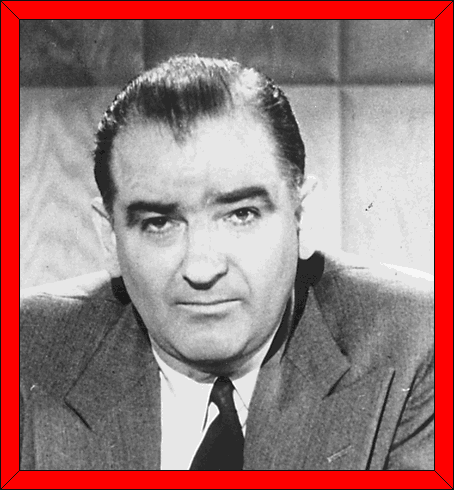

I recently viewed the best picture of the year 2005, in my opinion. The George Clooney directed, co-written and co-starred "Good Night and Good Luck," regarding CBS journalist Edward R. Murrow's public takedown of Senator Joseph McCarthy.
I hope that most of us know at least a little bit about the so-called "McCarthy Era," when the Cold War was still in its adolescent stages. Communists were supposedly infiltrating the United States' security measures with spies, threatening our freedom and our way of life. Senator McCarthy was the chairman of a Congressional committee to investigate any potential threats and indict individuals who might secretly be Communists.
But McCarthy went to far and began scaring anybody and everybody, persecuting probably innocent people and spreading paranoia (from Communists AND his own RADAR) far and abroad. For a wonderfully black and satiric comical work documenting the lunacy of that time, I would recommend 1964s "Dr. Strangelove: or How I Learned to Stop Worrying and Love the Bomb," directed by Stanley Kubrick.

But this blog is about Clooney's masterpiece. I was inspired by this movie to the point that I initiated a dialogue between my brother-in-law and father, via e-mail. Here are our thoughts:
MIKE:
Joe:
Yesterday I accidentally came in to work 2 hours early, so I had to take a 3-hour lunch. I wandered over to the Broadway and viewed the Clooney/Strathairn movie and loved it.
I think you mentioned that it was one of your year's favorites.
Do you think it might be subtle commentary on the news media's coverage of current affairs? President Bush and the war on terror in particular?
Today I think I'll go lunch at Curry in a Hurry. Remembering the hate crime on them four years ago with the arson has brought them to mind, and now I want tandoori chicken.
For whatever reason Clooney decided to make the film, it was smart, poignant and pregnant with extremely persuasive rhetoric. It was the perfect movie in that is was concise; only 90 very efficient minutes. The acting was brilliant.
JOE'S REPLY:
I think Cloony purposefully avoided commentary on current events. In this way the principles speak for themselves. It also makes the movie more timeless because it's a more accurate portrayal of the situation of the time. Having said that, though, it's easy to see parallels with current events. But that, again, will be what makes it timeless. Hopefully if it had been made exactly the same 10 years ago or 10 years into the future, someone would still wonder if
there was subtle commentary on current political events.
I feel sorry for McCarthy on many levels. I sincerely believe the majority of policy makers have good intentions. What the documentary didn't show (and really couldn't because of the context) was McCarthy's alcohol and drug addictions, which more or less killed him a few years later. I think some of his overt paranoia stemmed from that. Boy, I have to say, though, that even better that watching the press take him out was watching the fellow-Senators putting him in his place.
-Joseph
MIKE AGAIN:
Agreed--I, as well, am glad that there were no specific references to our times. Walking back to work I thought about how we should be more responsible for how we use, well, any sort of medium to communicate our thoughts. Where entertainment and enjoyment are essential to balance in our lives, words like "insulated" and "complacent" really made me wonder how responsible we as a people are with our newscasts, editorials published and televised, and right on down even to entertainment. Then zooming in on the individual, how responsible are we for what we view, and furthermore how responsible are we for what we portray in our own communications? ...or are we merely Sunday Christians?
It used to amaze me and catch my attention when I would find a true principle being preached and practiced outside of an explicit gospel context, but anymore I am not surprised. Truth is truth. If we can portray wisdom and charity beyond some compartmentalized portion of our lives (church), then I think we are making progress. The gospel should be relevant and present in all that we are.
It is nice to finally watch a movie and leaving thinking more than "that was a visual feast."
FRED:
Arthur Miller's great play "The Crucible" was written about the McCarthy terror, but placed during the Salem witch trials for several reasons, one of which was to keep Miller off McCarthy's list. Another was to show the timelessness of the struggle of truth and justice against prejudice, ignorance and mob mentality. By moving his anti-Bush feelings back 50 years in time, Clooney has done the same thing. Anyone who criticizes Bush and his cronies overtly is subjected to vicious smear attacks. By portraying McCarthy as the ignorant boob he was, Clooney can slam Bush and come away clean--because Dubya and his mob will NEVER see the parallels between themselves and McCarthy. They're just too bleeping stupid. At the same time, Clooney can educate us about a scary and important time in our nation's history. History is repeating itself and lives are being destroyed again in the same way because, as Hegel said, the one thing we learn from history is that no one ever learns anything from history.
Also, a true hero like Ed Murrow deserves to be dusted off and shown to new generations. Unfortunately, CBS would never employ a man like him nowadays, and the Hannitys and Limbaughs would be dumping their verbal manure all over him. I've always liked George Clooney, and now I have immense respect for him. This was a great movie.
I would welcome you all to view this movie and participate in our discussion. Post a message, e-mail me, whatever.
Dec 22, 2005
William Wines Phelps
Hello again. Still feeling quite sick yet needing to be present at work tomorrow, I retired early this evening. I turned the television on, enabled the 'sleep' feature, and commenced flipping through the channels. I stopped when I heard the deep, staccato pipes of Gregory Peck. Yes, Atticus Finch was narrating the Marriott-produced "American Prophet: the Joseph Smith Story".
While watching, I was reminded of a passage in a Jeffrey R. Holland book I recently read called "However Long and Hard the Road." It is a collection of some of Elder Holland's sermons, and I would like to straight-up quote a massive block of it for you now. It is from his talk entitled "A Robe, a Ring and a Fatted Calf." The talk was given on forgiveness and when I first read it I was moved to weep knowing that regardless of the most vile of offenses I have committed toward God, full fellowship with him is still ultimately possible.
I have Jesus Christ as a divine exemplar for forgiveness, as he is the catalyst of even the slightest bit of hope to repent and be forgiven. He is the Reason. But a very earthly example would be the most very reverend Joseph Smith. Quoting Elder Holland:

In the early years of the Church the Prophet Joseph Smith had no more faithful aide than WIlliam Wines Phelps. Brother Phelps, a former newspaper editor, had joined the Church in Kirtland and was of such assistance to those early leaders that they sent him as one of the first Latter-day Saints to the new Jerusalem--Jackson County, Missouri. There he was called by the Lord to the stake presidency of that "center stake of Zion."
But then troubles developed. First they were largely eccliastical aberrations but later there were financial imiproprieties. Things became so serious that the Lord revealed to Joseph Smith that if Brother Phelps did not repent, he would be "removed out of [his] place." (HC 2:511) He did not repent, and he was excommunicated on March 10, 1838.
The Prophet Joseph Smith and others immediately tried to love W. W. Phelps back into the fold, but he would have nothing of it. Then in the fall of that violent year Brother Phelps, along with others, signed a deadly, damaging affidavit against the Prophet and other leaders of the Church. The result was quite simply that Joseph Smith was sentenced to be publicly executed on the town square in Far West, Missouri, Friday morning, November 2, 1838. Through the monumental courage of General Alexander Doniphan, the Prophet was miraculously spared the execution W. W. Phelps and others had precipitated, but he was not spared spending five months--November through April--in several Missouri prisons, the most noted of which was the pit known ironically as Liberty Jail.
I do not need to recount for you the suffering of the Saints through that period. The anguish of those not captive was in many ways more severe than those imprisoned. The persecution intensified until the Saints sought yet again to find another refuge from the storm. With Joseph in chains, praying for their safety and giving some direction by letter, they made their way toward Commerce, Illinois, a malaria swamp on the Mississippi River where they would try once more to build the City of Zion. And much of this travail, this torment and heartache, was due to men of their own brotherhood like W. W. Phelps.
But we're speaking of happy endings. Two very difficult years later, with great anguish and remorse of conscience, William Phelps wrote to Joseph Smith in Nauvoo.
"Brother Joseph: ... I am as the prodigal son ...
"I have seen the folly of my way, and I tremble at the gulf I have passed ... [I] ask my old brethren to forgive me, and though they chasten me to death, yet I will die with them, for their God is my God. The least place with them is enough for me, yea, it is bigger and better than all Babylon ...
"I know my situation, you know it, and God knows it, and I want to be saved if my friends will help me ... I have done wrong and I am sorry ... I ask forgiveness ... I want your fellowhsip; if you cannot grant that, grant me your peace and friendship, for we are brethren, and our communion used to be sweet." (HC 4:141-42)
In an instant the Prophet wrote back. I know of no private document or personal response in the life of Joseph Smith--or anybody else, for that matter--that so powerfully demonstrates the magnificence of his soul. There is a lesson here for every one of us who claims to be a disciple of Christ. He wrote:
"Dear Brother Phelps: ... You may in some measure realize what my feelings ... were, when we read your letter ... We have suffered much in consequence of your behavior--the cup of gall, already full enough for mortals to drink, was indeed filled to overflowing when you turned against us...
"However, the cup has been drunk, the will of our Father has been done, and we are yet alive, for which we thank the Lord. And having been delivered from the hands of wicked men by the mercy of our God, we say it is your privilege to be delivered from the powers of the adversary, be brought into the liberty of God's dear children, and again take your stand among the Saints of the Most High, and by diligence, humility, and love unfeigned, commend yourself to our God, and your God, and to the Church of Jesus Christ.
"Believing your confession to be real, and your repentance genuine, I shall be happy once again to give you the right hand of fellowship, and rejoice over the returning prodigal...
"'Come in, dear brother, since the war is past,
For friends at first, are friends again at Last.'
"Yours as ever, Joseph Smith, Jun." (HC 4:162-64)
It only adds to the poignance of this particular prodigal's return that exactly four years later--almost to the day--it would be W. W. Phelps selected to preach Joseph Smith's funeral sermon in that terribly tense and emotional circumstance. Furthermore it would be W. W. Phelps who would memorialize the martyred prophet with his hymn of adoration, "Praise to the Man." (Hymns, no. 147)
Having been the foolish swimmer pulled back to safety by the very man he had sought to destroy, Brother Phelps must have had unique appreciation for the stature of the Prophet when he penned:
Great is his glory and endless his priesthood.
Ever and ever the keys he will hold.
Faithful and true, he will enter his kingdom,
Crowned in the midst of the prophets of old.
It was this hymn which tipped the scales while I was deciding to serve a mission.
I feel like Smith's Phelps when I think of a Christ, to whose suffering I have personally contributed, in addition to the sorrow our Father feels when I choose the wrong. But I am filled with gratitude when I know that I am loved enough to have been extended the chance of repentance, foregiveness and hope.

While watching, I was reminded of a passage in a Jeffrey R. Holland book I recently read called "However Long and Hard the Road." It is a collection of some of Elder Holland's sermons, and I would like to straight-up quote a massive block of it for you now. It is from his talk entitled "A Robe, a Ring and a Fatted Calf." The talk was given on forgiveness and when I first read it I was moved to weep knowing that regardless of the most vile of offenses I have committed toward God, full fellowship with him is still ultimately possible.
I have Jesus Christ as a divine exemplar for forgiveness, as he is the catalyst of even the slightest bit of hope to repent and be forgiven. He is the Reason. But a very earthly example would be the most very reverend Joseph Smith. Quoting Elder Holland:

In the early years of the Church the Prophet Joseph Smith had no more faithful aide than WIlliam Wines Phelps. Brother Phelps, a former newspaper editor, had joined the Church in Kirtland and was of such assistance to those early leaders that they sent him as one of the first Latter-day Saints to the new Jerusalem--Jackson County, Missouri. There he was called by the Lord to the stake presidency of that "center stake of Zion."
But then troubles developed. First they were largely eccliastical aberrations but later there were financial imiproprieties. Things became so serious that the Lord revealed to Joseph Smith that if Brother Phelps did not repent, he would be "removed out of [his] place." (HC 2:511) He did not repent, and he was excommunicated on March 10, 1838.
The Prophet Joseph Smith and others immediately tried to love W. W. Phelps back into the fold, but he would have nothing of it. Then in the fall of that violent year Brother Phelps, along with others, signed a deadly, damaging affidavit against the Prophet and other leaders of the Church. The result was quite simply that Joseph Smith was sentenced to be publicly executed on the town square in Far West, Missouri, Friday morning, November 2, 1838. Through the monumental courage of General Alexander Doniphan, the Prophet was miraculously spared the execution W. W. Phelps and others had precipitated, but he was not spared spending five months--November through April--in several Missouri prisons, the most noted of which was the pit known ironically as Liberty Jail.
I do not need to recount for you the suffering of the Saints through that period. The anguish of those not captive was in many ways more severe than those imprisoned. The persecution intensified until the Saints sought yet again to find another refuge from the storm. With Joseph in chains, praying for their safety and giving some direction by letter, they made their way toward Commerce, Illinois, a malaria swamp on the Mississippi River where they would try once more to build the City of Zion. And much of this travail, this torment and heartache, was due to men of their own brotherhood like W. W. Phelps.
But we're speaking of happy endings. Two very difficult years later, with great anguish and remorse of conscience, William Phelps wrote to Joseph Smith in Nauvoo.
"Brother Joseph: ... I am as the prodigal son ...
"I have seen the folly of my way, and I tremble at the gulf I have passed ... [I] ask my old brethren to forgive me, and though they chasten me to death, yet I will die with them, for their God is my God. The least place with them is enough for me, yea, it is bigger and better than all Babylon ...
"I know my situation, you know it, and God knows it, and I want to be saved if my friends will help me ... I have done wrong and I am sorry ... I ask forgiveness ... I want your fellowhsip; if you cannot grant that, grant me your peace and friendship, for we are brethren, and our communion used to be sweet." (HC 4:141-42)
In an instant the Prophet wrote back. I know of no private document or personal response in the life of Joseph Smith--or anybody else, for that matter--that so powerfully demonstrates the magnificence of his soul. There is a lesson here for every one of us who claims to be a disciple of Christ. He wrote:
"Dear Brother Phelps: ... You may in some measure realize what my feelings ... were, when we read your letter ... We have suffered much in consequence of your behavior--the cup of gall, already full enough for mortals to drink, was indeed filled to overflowing when you turned against us...
"However, the cup has been drunk, the will of our Father has been done, and we are yet alive, for which we thank the Lord. And having been delivered from the hands of wicked men by the mercy of our God, we say it is your privilege to be delivered from the powers of the adversary, be brought into the liberty of God's dear children, and again take your stand among the Saints of the Most High, and by diligence, humility, and love unfeigned, commend yourself to our God, and your God, and to the Church of Jesus Christ.
"Believing your confession to be real, and your repentance genuine, I shall be happy once again to give you the right hand of fellowship, and rejoice over the returning prodigal...
"'Come in, dear brother, since the war is past,
For friends at first, are friends again at Last.'
"Yours as ever, Joseph Smith, Jun." (HC 4:162-64)
It only adds to the poignance of this particular prodigal's return that exactly four years later--almost to the day--it would be W. W. Phelps selected to preach Joseph Smith's funeral sermon in that terribly tense and emotional circumstance. Furthermore it would be W. W. Phelps who would memorialize the martyred prophet with his hymn of adoration, "Praise to the Man." (Hymns, no. 147)
Having been the foolish swimmer pulled back to safety by the very man he had sought to destroy, Brother Phelps must have had unique appreciation for the stature of the Prophet when he penned:
Great is his glory and endless his priesthood.
Ever and ever the keys he will hold.
Faithful and true, he will enter his kingdom,
Crowned in the midst of the prophets of old.
It was this hymn which tipped the scales while I was deciding to serve a mission.
I feel like Smith's Phelps when I think of a Christ, to whose suffering I have personally contributed, in addition to the sorrow our Father feels when I choose the wrong. But I am filled with gratitude when I know that I am loved enough to have been extended the chance of repentance, foregiveness and hope.
Dec 21, 2005
Festivus is fine for some, but I'll celebrate Hammocka.
So here I sit in my freezing house (thanks, Questar), home ill with some sort of mutated throat ailment. I just slicked up a plate of curry rice and am listening to Van Morrison. He's one of those guys who employs jazz in pop and it works.
I recently was directed to an Onion article by fellow JeTSaM (it's like Hebrew: insert the vowels of your choice) alum Logan "what's worse than a tornado?" Mickel. He, Sorro, my father and I were about to be served Japo-American fast food by non-Asians at the Gateway Mall in former Vagrantville, UT. The former two were headed to the SLC U2 concert, I was off to see King Kong with my pops (I sold my U2 ticks because I have a penchant for food). I vaguely reminisced the infographic on the Onion where it mentioned that the Edge betrayed Bono for 20 pieces of silver. Logan "I love throwing balls at your crotch" Mickel mentioned this little nugget.
What's the deal with people assimilating pop-culture into their own lives? Apparently, according to Logan "I would like to purchase that monkey" Mickel, there is some municipal building somewhere with a Festivus pole on the lawn. Funny? Oh, yes. But also unoriginal. Let me tell you about Hammocka.
There was once a brilliant, melancholy apostate named Jared "Shaddow" Robbins. He was my roommate, and we conceptualized Hammocka. His disdain for any holiday celebrated around the winter solstice sparked the invention of this demiholiday. Yes, unoriginal as well, but at least we invented our own traditions. For example, during the Hammocka season it is requisite for any person exiting the shower to play Nintendo while sitting in a hair-dryer chair. Anybody entering a home that celebrates Hammocka must provide sufficient proof that he/she is not a velociraptor. Instead of a jolly man dispensing gifts (e.g. Santa Claus or Hanukkah Harry), Hammocka comes with a villainous raptor named Adrian, Vallery or Ryan. 'Adrian' is more of a placeholder name; the raptor actually represents any unwanted person who persists in coming over and overstaying.
Also at Hammocka, golf tees and milk caps are attached to doorways with adhesive. This has to do with the raptor problem. Legend has it that the Hammocka raptor will smell the milk, trot over to the source and consequently become impaled on the tees.
Hammocka homes will always be decorated with, of course, a hammock. Feel free to adorn the hammock with more mainstream Christmas-style ornaments, or be creative: decorate it with pictures of Patrick Duffy or Ken. In addition to the hammock, every Hammocka home will have a Scantron machine for grading those pesky tests, a cash register, and will have their hallway papered with aluminum (tin will do) foil. Green lightbulbs to add an eerie space-station glow are commonly employed in the foil portal.
Hammockers traditionally have an unfounded hate for Canada, yet ironically, all hold official government office. For example, Shaddow was Secretary of State. I was Secretary of Defense. Our home was renamed "Space Station Canada." This is typical behavior during the season.
An optional celebratory measure of some would be to make impromptu road trips to Las Vegas to watch WCW, 311 or to get something pierced.
Hammockers will drink milk from the carton while sitting around a fake mantle, somehow procured from somebody's former stage crew operation. They will also go into chatrooms on the Internet, secretly attach themselves to the biggest asshole in said room, gang up on him and turn the everybody against this cyberbully. When he tries to go to another room, the attached will follow him, much to their own selfish delight.
Hammocka was first celebrated from the beginning of September 1997 through mid-June 1998, having only ever taken place once in all of human history. It's co-inventor brought to pass the demise of annual celebration of this holiday in April of 1999. Hammocka is now as perpetual as our celebration of Shaddow's life and friendship.
Rest in peace, Shaddow.

I recently was directed to an Onion article by fellow JeTSaM (it's like Hebrew: insert the vowels of your choice) alum Logan "what's worse than a tornado?" Mickel. He, Sorro, my father and I were about to be served Japo-American fast food by non-Asians at the Gateway Mall in former Vagrantville, UT. The former two were headed to the SLC U2 concert, I was off to see King Kong with my pops (I sold my U2 ticks because I have a penchant for food). I vaguely reminisced the infographic on the Onion where it mentioned that the Edge betrayed Bono for 20 pieces of silver. Logan "I love throwing balls at your crotch" Mickel mentioned this little nugget.
What's the deal with people assimilating pop-culture into their own lives? Apparently, according to Logan "I would like to purchase that monkey" Mickel, there is some municipal building somewhere with a Festivus pole on the lawn. Funny? Oh, yes. But also unoriginal. Let me tell you about Hammocka.
There was once a brilliant, melancholy apostate named Jared "Shaddow" Robbins. He was my roommate, and we conceptualized Hammocka. His disdain for any holiday celebrated around the winter solstice sparked the invention of this demiholiday. Yes, unoriginal as well, but at least we invented our own traditions. For example, during the Hammocka season it is requisite for any person exiting the shower to play Nintendo while sitting in a hair-dryer chair. Anybody entering a home that celebrates Hammocka must provide sufficient proof that he/she is not a velociraptor. Instead of a jolly man dispensing gifts (e.g. Santa Claus or Hanukkah Harry), Hammocka comes with a villainous raptor named Adrian, Vallery or Ryan. 'Adrian' is more of a placeholder name; the raptor actually represents any unwanted person who persists in coming over and overstaying.
Also at Hammocka, golf tees and milk caps are attached to doorways with adhesive. This has to do with the raptor problem. Legend has it that the Hammocka raptor will smell the milk, trot over to the source and consequently become impaled on the tees.
Hammocka homes will always be decorated with, of course, a hammock. Feel free to adorn the hammock with more mainstream Christmas-style ornaments, or be creative: decorate it with pictures of Patrick Duffy or Ken. In addition to the hammock, every Hammocka home will have a Scantron machine for grading those pesky tests, a cash register, and will have their hallway papered with aluminum (tin will do) foil. Green lightbulbs to add an eerie space-station glow are commonly employed in the foil portal.

Hammockers traditionally have an unfounded hate for Canada, yet ironically, all hold official government office. For example, Shaddow was Secretary of State. I was Secretary of Defense. Our home was renamed "Space Station Canada." This is typical behavior during the season.
An optional celebratory measure of some would be to make impromptu road trips to Las Vegas to watch WCW, 311 or to get something pierced.
Hammockers will drink milk from the carton while sitting around a fake mantle, somehow procured from somebody's former stage crew operation. They will also go into chatrooms on the Internet, secretly attach themselves to the biggest asshole in said room, gang up on him and turn the everybody against this cyberbully. When he tries to go to another room, the attached will follow him, much to their own selfish delight.
Hammocka was first celebrated from the beginning of September 1997 through mid-June 1998, having only ever taken place once in all of human history. It's co-inventor brought to pass the demise of annual celebration of this holiday in April of 1999. Hammocka is now as perpetual as our celebration of Shaddow's life and friendship.
Rest in peace, Shaddow.
Oct 18, 2005
Intense
Friends, what else can I say but that it is extremely intense down here. I have called home to my family and a couple of friends, and have learned that unless I want to start crying, I should be general and vague in my response to the inevitable "so how is it down there?"
For those unaware, I am in the middle of a three-week assignment on official Red Cross duty. I am currently assigned to the East Houma Gym Shelter, in the city of Houma, Terrebonne Parish, Louisiana. These citizens are suffering intensely the effects caused by hurricanes Katrina and Rita. My job functions at the shelter are sundry, and include: delivering evecuees' possessions to newly found living quarters (usually trailers), kitchen duty, child recreation, registration/information desk, shower duty, night shift (which is what I am doing this very moment), cot sanitization, ... the list just goes on and on.
Upon initial arrival, we newbies were told that everybody breaks down at one point. This is not a bad thing, I believe, but rather an indication of one's humanity; that we have hearts. We all experience 'breakdown' differently, but we all agree that our emotional limitations are breached far sooner than those physical. Some of the shelter clients are very easy to get to know, and very loveable, while others remain more aloof and private. Yet all of them communicate their hardship one way or another, digitally expressed or analogous.
Friends, I admit right now that I am not in the clearest of minds and am thinking of calling this my blog for the now, but I need to retain some of these things and get them out now. I can always edit later, so forgive my scatterbrainedness.
Pressing on, I was saying that some of the people will just out and tell you everything. They need to. It is how they heal. Others will remain quietly pensive. The horror stories I am hearing from those who have been abroad in the area, however, indicate some of the worst these folks have experienced but aren't yet ready to express. Tomorrow is my day off and I plan on travelling to New Orleans and Slidell to see first-hand, but for now I will relay to you what I have only heard (may contain hyperbole). There are dead cows and horses 20-feet up in trees. Entire houses are found dozens of yards away from their foundations. On many stretches of road, one would believe that they are driving through the city junk yard. Shrimping and casino boats are found miles inland. Grand Isle, a resort of sorts, has been reduced to a sandbar. One woman told me that the entire island had washed away, but this is not the case.
Ugh, no, I won't be able to complete this blog now.
For those unaware, I am in the middle of a three-week assignment on official Red Cross duty. I am currently assigned to the East Houma Gym Shelter, in the city of Houma, Terrebonne Parish, Louisiana. These citizens are suffering intensely the effects caused by hurricanes Katrina and Rita. My job functions at the shelter are sundry, and include: delivering evecuees' possessions to newly found living quarters (usually trailers), kitchen duty, child recreation, registration/information desk, shower duty, night shift (which is what I am doing this very moment), cot sanitization, ... the list just goes on and on.
Upon initial arrival, we newbies were told that everybody breaks down at one point. This is not a bad thing, I believe, but rather an indication of one's humanity; that we have hearts. We all experience 'breakdown' differently, but we all agree that our emotional limitations are breached far sooner than those physical. Some of the shelter clients are very easy to get to know, and very loveable, while others remain more aloof and private. Yet all of them communicate their hardship one way or another, digitally expressed or analogous.
Friends, I admit right now that I am not in the clearest of minds and am thinking of calling this my blog for the now, but I need to retain some of these things and get them out now. I can always edit later, so forgive my scatterbrainedness.
Pressing on, I was saying that some of the people will just out and tell you everything. They need to. It is how they heal. Others will remain quietly pensive. The horror stories I am hearing from those who have been abroad in the area, however, indicate some of the worst these folks have experienced but aren't yet ready to express. Tomorrow is my day off and I plan on travelling to New Orleans and Slidell to see first-hand, but for now I will relay to you what I have only heard (may contain hyperbole). There are dead cows and horses 20-feet up in trees. Entire houses are found dozens of yards away from their foundations. On many stretches of road, one would believe that they are driving through the city junk yard. Shrimping and casino boats are found miles inland. Grand Isle, a resort of sorts, has been reduced to a sandbar. One woman told me that the entire island had washed away, but this is not the case.
Ugh, no, I won't be able to complete this blog now.
Oct 8, 2005
Baton Rouge
Leaving for the Gulf Coast from 10/9-10/24.
For a while, as I waited and waited and waited for word from the ARC, I thought, "perhaps God was wondering if I was willing to sacrifice some things in my life, and he wants to see how I will react to not going after having done such." Then I worked to come to grips with that. As time passed, I was growing increasingly worried about my joblessness, and as the weeks passed with no call, I thought "if I don't go this week, I'm just going to go ahead and hunt for a job in earnest." That is what I did.
After a few interviews (and no call-backs yet) I finally got a call from the ARC. I had to think for a moment, but then decided rather quickly to go for it.
I thought that maybe I don't have to go do some great and grand thing to be charitable. I can do that for the people within my own sphere, and on a regular basis and perhaps with a greater impact, as there is reciprocating emotional investiture. I don't need to go galavanting off somewhere to be useful to my fellow man. Maybe I could be a more genuine brother, friend, son, etc. Maybe I could live up to my ideals and spread charity to those with whom I am closest. Or, yeah, sure, I could go off a thousand miles, tell everybody about it, and be thought of as a good guy.
Well, I would rather just do what I can and be square with my interpretation of God. I would rather have his praise than my fellow human peers.
My friend Katie organized just last night a small group of us to go shopping off of a list given her by the SLC downtown youth homeless shelter. We got socks, canned food, notepads, hats, gloves, treats, batteries...quite a bit of stuff for relatively cheap. We returned back to the shelter and heard one of the workers say "ooh, socks!" My friends were commenting on how it made them feel to hear her say that about something to which they had contributed.
I decided to be a better person to those around me, and then got word that I need to be ready to leave for Baton Rouge within 24-36 hours. Like Peter Griffin off "Family Guy" when he died prematurely. Death told him that even though he was early and that he'd be going back, he wouldn't be allowed to return to his body until he received an epiphany about his life. Well, I got my epiphany, I hope to take it seriously. I can do macro-service or micro-service (hopefully both), but I will not overlook those near to me by going for something larger.
I'll let you know how it goes down South.
For a while, as I waited and waited and waited for word from the ARC, I thought, "perhaps God was wondering if I was willing to sacrifice some things in my life, and he wants to see how I will react to not going after having done such." Then I worked to come to grips with that. As time passed, I was growing increasingly worried about my joblessness, and as the weeks passed with no call, I thought "if I don't go this week, I'm just going to go ahead and hunt for a job in earnest." That is what I did.
After a few interviews (and no call-backs yet) I finally got a call from the ARC. I had to think for a moment, but then decided rather quickly to go for it.
I thought that maybe I don't have to go do some great and grand thing to be charitable. I can do that for the people within my own sphere, and on a regular basis and perhaps with a greater impact, as there is reciprocating emotional investiture. I don't need to go galavanting off somewhere to be useful to my fellow man. Maybe I could be a more genuine brother, friend, son, etc. Maybe I could live up to my ideals and spread charity to those with whom I am closest. Or, yeah, sure, I could go off a thousand miles, tell everybody about it, and be thought of as a good guy.
Well, I would rather just do what I can and be square with my interpretation of God. I would rather have his praise than my fellow human peers.
My friend Katie organized just last night a small group of us to go shopping off of a list given her by the SLC downtown youth homeless shelter. We got socks, canned food, notepads, hats, gloves, treats, batteries...quite a bit of stuff for relatively cheap. We returned back to the shelter and heard one of the workers say "ooh, socks!" My friends were commenting on how it made them feel to hear her say that about something to which they had contributed.
I decided to be a better person to those around me, and then got word that I need to be ready to leave for Baton Rouge within 24-36 hours. Like Peter Griffin off "Family Guy" when he died prematurely. Death told him that even though he was early and that he'd be going back, he wouldn't be allowed to return to his body until he received an epiphany about his life. Well, I got my epiphany, I hope to take it seriously. I can do macro-service or micro-service (hopefully both), but I will not overlook those near to me by going for something larger.
I'll let you know how it goes down South.
Sep 28, 2005
"You must be the change you wish to see in the world" -Gandhi
Tonight I will draw from Ray Bradbury, PBS, "Friends" and my own life to make my point. My thoughts are here and there tonight, but will come together if you read through to termination.
I'll just start off by referencing a story called "The Fire Balloons" by Ray Bradbury. It is a short story about a missionary expedition to Mars. The fathers have no luck in coaxing the Martians from their hills to worship their cruicifixes or participate in communion. One astute father decides that since they are on Mars, maybe the Martians cannot relate to a humanoid representation of Christ or do not feel comfortable worshipping in a chapel with walls and pews. He sets out to the hills to set up a place of worship in nature, and constructs a globe of glowing blue fire, for that is what he hears the ancient Martians look like. He takes this placeholder fire balloon and calls it Christ. He encounters the Martians and they teach him much more than he could have taught them. I will refer to this story again at the end.
Next: I just finished watching "Get Up Stand Up" on KUED/PBS about music and politics, and it is making my mind reel. I tuned in after scanning the channels because I saw George Harrison singing "While My Guitar Gently Weeps." I didn't know that it was a shot from his benefit concert to aid Bangladesh. That was two hours ago, and I watched the entire program.
Sir Bob Geldof (of Live Aid fame and 2006 Nobel Peace Prize nominee) was a focal point, as was Bono of U2 (2006 Nobel Peace Prize nominee), and the entire rap music genre. So many political and economic opinions were flying all around representing so many different ideas. Some overlapped and were harmonious while others clashed. The clashing points were along the lines of how to resolve the issues of the world. The agreements were on the issues: AIDS, Tibet, African debt, apartheid, racism, war, the caste system alive and well in the USA, and on and on. Geldof said "Bono loves the world, and I hate it. He just wants to give it a big hug, and I want to punch its lights out!" Opposite extremes of the idealist and the pragmatist. But they are very good friends and often found working together to do what they can to give aid to the many many different relief efforts in which they are involved. Reraphrasing Geldof again, he said he called it "Band Aid" because that's all it was: a band aid, a temporary fix and patch-job. It will not solve the problem.
This made me think: a while ago I was in therapy. My psychologist suggested that perhaps my temper and other bad habits were not the problem, but rather symptoms of a deeper problem, a deeper sickness. That sickness was self-loathing. I did not love myself, and therefore acted out in certain ways. I did my best to control my temper, but eventually I would slip up and act out. Why? Because I still did not love myself. As I have been studying myself and the gospel and realizing that I am loveable, loving and wonderful, I must say that those symptoms have waned and waned.
Echoing Geldof's sentiments, raising money to feed the starving African children or to pay off the mortgages of midwest farmers' property does not solve the problem. It will help a minute fragment of those aching for aid, but the real purpose of the concerts was not to raise money--it was to raise awareness. There will always be starving children, AIDS is rampant in Africa as well, black America, despite their humanity (reason, intellect, compassion, etc.), struggle to break out of their economic tier because they are raised to fulfill stereotypes. Sociality precludes or pervades the idealistic humanity and the goodness in us all. We let it trump our souls with false and fleeting joys that should be associated with being alive.
To draw on the insightful moment I had while watching "Friends" (of all shows): Phoebe was dating a psychiatrist who alienated the rest of the group by accurately analyzing their faults and idiosynchracies and drawing their insecurities out in front of everyone. When told that he was disliked by Phoebe's friends, he broke almost into soliloquy about them, saying something like "this doesn't suprise me--their egos are so fragile, they don't know who they are. 'Define me! define me!' As if they need each other to feel special."
"Define me." What am I to whom? I am a son, a brother, an uncle, a friend. I am a child of God. This is what helped me to love myself and change my attitude: that I am special not because I drive what I do or because of some other superficial or temporal device. I fit somewhere in the universe as a needed and special piece. Others need me, and I need them.
This example from my life illustrates how the gospel of Jesus Christ gave me the aid that I need. Going back to Bob and Bono, applying dollars and cents is a rather futile means and yields no end. It is an external wisp of aid (though much good has been done). No, I proclaim that we as children of God need to recognize that within ourselves lies the ability to change the world as we band together. I believe that the gospel of Jesus Christ can save the world.
Agnostics, don't stop reading. This ends up where we began, with the Nazarene as a blue phosphorescent globe. You see, the point isn't that we change one another to worship the olive-skinned Jesus. It isn't the man which drives humanity. Siddhartha Gautama, Zarathustra, Socrates, Roseanne Barr, Frodo Baggins or soylent green aren't the point. The point is what they represent. My fire balloon is Jesus Christ, happiness, joy, morality, faith and all of that. Another's fire balloon may be existential philosophy, while yet another might represent Allah. We take our fire balloons and give them a name (which is fine), but then we impose upon others to take the same stance as we do. No, we should be inviting others to partake of the ideals to which we adhere, and then accept the invitation to peer into their balloon and add to our own wholesomeness. We have only our innate, primal goodness to offer one another, but when we throw up labels and start defining ourselves as Mormons, atheists, lesbians, Japanese, etc., we forget that we are all humans.
So we know who I believe my fire balloon to be. I am obviously Christian, and of the Mormon "division" at that. What is in yours? Who is in yours? What do you believe? Do you believe in love? Do you believe in peace and brotherhood? Do you believe in charity? Me too. So let's take Gandhi's advice and start a revolution. Let US be the change in the world and fill it with communal love. Let's invite others to find the commonalities we learn from our balloons (they are most certainly there) and move forward shoulder-to-shoulder. Let our revolution be peaceful, like through song, expressive and stimulating to others. We all have bruised souls, we do not need to exacerbate the situation by crusading about with a Bible and a gun. Let our label read "humanity" as we care for one and all; e pluribus unum, indeed. I am doing what I can to be the change I wish to see in the world.
I'll just start off by referencing a story called "The Fire Balloons" by Ray Bradbury. It is a short story about a missionary expedition to Mars. The fathers have no luck in coaxing the Martians from their hills to worship their cruicifixes or participate in communion. One astute father decides that since they are on Mars, maybe the Martians cannot relate to a humanoid representation of Christ or do not feel comfortable worshipping in a chapel with walls and pews. He sets out to the hills to set up a place of worship in nature, and constructs a globe of glowing blue fire, for that is what he hears the ancient Martians look like. He takes this placeholder fire balloon and calls it Christ. He encounters the Martians and they teach him much more than he could have taught them. I will refer to this story again at the end.
Next: I just finished watching "Get Up Stand Up" on KUED/PBS about music and politics, and it is making my mind reel. I tuned in after scanning the channels because I saw George Harrison singing "While My Guitar Gently Weeps." I didn't know that it was a shot from his benefit concert to aid Bangladesh. That was two hours ago, and I watched the entire program.
Sir Bob Geldof (of Live Aid fame and 2006 Nobel Peace Prize nominee) was a focal point, as was Bono of U2 (2006 Nobel Peace Prize nominee), and the entire rap music genre. So many political and economic opinions were flying all around representing so many different ideas. Some overlapped and were harmonious while others clashed. The clashing points were along the lines of how to resolve the issues of the world. The agreements were on the issues: AIDS, Tibet, African debt, apartheid, racism, war, the caste system alive and well in the USA, and on and on. Geldof said "Bono loves the world, and I hate it. He just wants to give it a big hug, and I want to punch its lights out!" Opposite extremes of the idealist and the pragmatist. But they are very good friends and often found working together to do what they can to give aid to the many many different relief efforts in which they are involved. Reraphrasing Geldof again, he said he called it "Band Aid" because that's all it was: a band aid, a temporary fix and patch-job. It will not solve the problem.
This made me think: a while ago I was in therapy. My psychologist suggested that perhaps my temper and other bad habits were not the problem, but rather symptoms of a deeper problem, a deeper sickness. That sickness was self-loathing. I did not love myself, and therefore acted out in certain ways. I did my best to control my temper, but eventually I would slip up and act out. Why? Because I still did not love myself. As I have been studying myself and the gospel and realizing that I am loveable, loving and wonderful, I must say that those symptoms have waned and waned.
Echoing Geldof's sentiments, raising money to feed the starving African children or to pay off the mortgages of midwest farmers' property does not solve the problem. It will help a minute fragment of those aching for aid, but the real purpose of the concerts was not to raise money--it was to raise awareness. There will always be starving children, AIDS is rampant in Africa as well, black America, despite their humanity (reason, intellect, compassion, etc.), struggle to break out of their economic tier because they are raised to fulfill stereotypes. Sociality precludes or pervades the idealistic humanity and the goodness in us all. We let it trump our souls with false and fleeting joys that should be associated with being alive.
To draw on the insightful moment I had while watching "Friends" (of all shows): Phoebe was dating a psychiatrist who alienated the rest of the group by accurately analyzing their faults and idiosynchracies and drawing their insecurities out in front of everyone. When told that he was disliked by Phoebe's friends, he broke almost into soliloquy about them, saying something like "this doesn't suprise me--their egos are so fragile, they don't know who they are. 'Define me! define me!' As if they need each other to feel special."
"Define me." What am I to whom? I am a son, a brother, an uncle, a friend. I am a child of God. This is what helped me to love myself and change my attitude: that I am special not because I drive what I do or because of some other superficial or temporal device. I fit somewhere in the universe as a needed and special piece. Others need me, and I need them.
This example from my life illustrates how the gospel of Jesus Christ gave me the aid that I need. Going back to Bob and Bono, applying dollars and cents is a rather futile means and yields no end. It is an external wisp of aid (though much good has been done). No, I proclaim that we as children of God need to recognize that within ourselves lies the ability to change the world as we band together. I believe that the gospel of Jesus Christ can save the world.
Agnostics, don't stop reading. This ends up where we began, with the Nazarene as a blue phosphorescent globe. You see, the point isn't that we change one another to worship the olive-skinned Jesus. It isn't the man which drives humanity. Siddhartha Gautama, Zarathustra, Socrates, Roseanne Barr, Frodo Baggins or soylent green aren't the point. The point is what they represent. My fire balloon is Jesus Christ, happiness, joy, morality, faith and all of that. Another's fire balloon may be existential philosophy, while yet another might represent Allah. We take our fire balloons and give them a name (which is fine), but then we impose upon others to take the same stance as we do. No, we should be inviting others to partake of the ideals to which we adhere, and then accept the invitation to peer into their balloon and add to our own wholesomeness. We have only our innate, primal goodness to offer one another, but when we throw up labels and start defining ourselves as Mormons, atheists, lesbians, Japanese, etc., we forget that we are all humans.
So we know who I believe my fire balloon to be. I am obviously Christian, and of the Mormon "division" at that. What is in yours? Who is in yours? What do you believe? Do you believe in love? Do you believe in peace and brotherhood? Do you believe in charity? Me too. So let's take Gandhi's advice and start a revolution. Let US be the change in the world and fill it with communal love. Let's invite others to find the commonalities we learn from our balloons (they are most certainly there) and move forward shoulder-to-shoulder. Let our revolution be peaceful, like through song, expressive and stimulating to others. We all have bruised souls, we do not need to exacerbate the situation by crusading about with a Bible and a gun. Let our label read "humanity" as we care for one and all; e pluribus unum, indeed. I am doing what I can to be the change I wish to see in the world.
Sep 17, 2005
Matthew 25:40
Friends:
I have been criticized, supported, shunned and embraced for my recent choices in forfeiting a plausible career occupation for a mere three-week period during which I will be staying in and helping with a shelter in the South for the American Red Cross.
Perhaps the following goings-on of my mind chronologically laid out for you will help those who would like to understand my motives. Perhaps it may quell the naysayers, perhaps it will incite more opposition. Regardless, these are my experiences and my decisions. This is what makes me me, as yours make you you. I take criticism and feedback (though not always graciously, at first) and appreciate any comments. An experience you have had may well help me to grow. And hopefully my life can help you as well.
If you are a reader of my blog, you are already aware that I am a Utah-bred member of the LDS church, served a full-time youth mission, and since returning home have faced some adversity, causing me to dig deep into my beliefs and purpose (or sense of purpose). Even considering rerouting my lifestyle entirely, these last couple of years during which I battled depression amongst other things, the results are in: I have decided to rewire my beliefs based more upon principles taught in my faith, rather than upon rules and regulations, the dos and don'ts. I have reprogrammed my code and hopefully left enough room for future change; I plan on leaving my interpretations of doctrine open to future change and recoding. I would like to be dynamic and flexible within my beliefs, but have decided that I will not change them from pure Mormon doctrine.
I have made poor decisions which have landed me outside of the boundaries required for temple attendance. Okay, here is where the point of today's 'blog comes in: why am I leaving my job to help strangers?
In working with my bishop and as he has helped me to understand the relationship between Jesus and me, I have done a lot of studying: reading from scripture and the endless commentary on such; studying of myself...and on and on. I think a lot, and in my pursuit to find truth (or perceived truth), these activities have led me to the light offered by the Gift of the Holy Ghost. Or rather, it helped me to stop ignoring his influence and actually seemed to amplify it. And this is what I feel from him.
I know that as noble and good as my life has been at times, there also exist deeds and practices which go against the will of God. With these irreversible blemishes present, I cannot fulfill my purpose of gaining substantial happiness. So we have been given a Jesus figure to give us aid in reconciling the wrongs we have done, and he therefore deserves our worship.
Yes, worship. This term is appropriate. I have thought a lot about how I could pay him back, because at times of prayer I have felt so intensely feelings of gratitude and love, I have wanted to shout "how can I pay you back!" Yes, how can we pay him back? Um...not possible. In studying theology, I have concluded that we cannot do it. If we are capable of repaying him, man repaying Deity, we should also be capable of making ourselves square with God sans Jesus Christ, and this is not the case.
So I say that we should worship him as a form of payback, as best as mortals can. He offers us ways that we can worship him, and I have discovered something vitalizing within Matthew 25:40. How many times have I read this verse? But this time I read it with a stronger motivation to fulfill it.
I turned my attention to how I could be a contributer to my community, other communities, individuals, whomever. I tried to volunteer to help with the Church's need of bodies in the Perpetual Education Fund, but currently they only need bilingual English/Spanish speakers, and I was turned down. At every chance I had to sign up for a service project, I would. I started stopping to help distressed motorists on the highway every time. I tried to make a conscious effort to seek out the needs in others, but although the young ladies with the flat tire were grateful, I still didn't feel like I was doing enough.
Then I looked at myself. I own four bicycles: road bike, $1,000; mountain bike hard-tail, $3,000; mountain bike soft-tail, $5,000; commuter bike, $700. Friends, I only have two legs and one butt, so who needs all of those bikes? Upstairs I have a home theater that I never use. I have meals everyday, I sleep in a bed, I enjoy movies and pizza and leisure.
Without the news media, I would never have known about Katrina. I thought of people young and old who may not know where their family members are, relocated to a new locale, their lives washed away by nature's gale. They probably don't even have a picture of their families, and I am sitting here with four bikes--and the debt accumulated in building them. This most certainly does not sit right with me. As I went to a pre-volunteer orientation presented by the American Red Cross, it became so clear that this is an ideal channel for me to give of myself. I am weary of being a Christian grandstander, voicing strong approval of service and charity and love and compassion yet not having the courage to step outside of myself and my comfort zone to do something. When asked if I would be willing to relocate and offer aid in manning the Red Cross shelters in the South, I replied affirmatively.
This meant that I would have to request leave from my employer, WorkingRx. I was not only denied leave but was told that if I choose to depart for three weeks that my position would be filled, as my duties are somewhat specialized and I am the only person who carries them out. In all honesty, I foresaw this. What I did not expect was their complacency to the entire situation. In essence, I was forced to resign. I posed the option of reassigning me somewhere within the company infrastructure, as it is a growing company and I would require much less training than an outside hire. They asked me to reapply as an outside hire. Now, replacing me in my position was an expected sound business decision. Yet asking me to reapply sounds more like spite or pettiness or some other cheap tactic, which has really smothered my desire to be further affiliated with WorkingRx. I asked human resources if they are involved in any community- or education-minded charity or any humanitarian cause--they said no. I requested of the HR Director (Joel Deaton) and the CEO (Bob McCaffrey) that they discuss it with the Board, and was outright ignored.
So, they left it up to me: stay in my position after being completely turned off by the company and have job security, or volunteer for something I believe in and resign with a possibility of coming back if I reapplied. Honestly, my reaction was silent and remained in my head, but I really wanted to tell them to do a four-letter word to themselves. If I have to reapply without the consideration of my hard work and job experience with the same company, then I would rather seek my fortune elsewhere.
A few months ago, I was approached by founder, former CEO, current board member and employee of Samaritan Technologies, Joseph Wecker, with the possibility of becoming part of their work force. It excited me then and it excites me now, and I will tell you why.
You can begin by looking at the name of their company; it is not hard to decipher its etymology. It is a software company that writes database software, in essence, to track volunteers and volunteer opportunites within the various programs and organizations. These organizations become not only more effective in rendering volunteer services by efficiently tracking pertinent information with the software, but it creates man hours for more volunteer service to be done.
Samaritan also mandates volunteerism from its employees, quoting from their Web site without permission, "At Samaritan we are very committed to volunteerism. Each of our full-time permanent employees volunteers four hours per month in his or her community."
This is the kind of organization with which I seek to be affiliated. I realize the importance of being self-reliant and earning a livelihood not only for myself but for my family and loved ones. I need an income to survive in this moneymongering society, but do I have to earn that income from a moneymongering employer couched in apathy?
So be it with Samaritan, the Red Cross, the Boy Scouts or whatever company I land in, I would be happy knowing that my employment comes from a company that is good for 1) its community; 2) its employees; and 3) for promoting humanitarian attitudes in everybody.
In the meantime, I am selling all of my things to pay my bills while I am out of work for at least the next six weeks. Contact me for a list of items for sale and their prices, or if you would just like to donate.
God bless you all.
love, Mike
801-554-8792
genkibrady@gmail.com
I have been criticized, supported, shunned and embraced for my recent choices in forfeiting a plausible career occupation for a mere three-week period during which I will be staying in and helping with a shelter in the South for the American Red Cross.
Perhaps the following goings-on of my mind chronologically laid out for you will help those who would like to understand my motives. Perhaps it may quell the naysayers, perhaps it will incite more opposition. Regardless, these are my experiences and my decisions. This is what makes me me, as yours make you you. I take criticism and feedback (though not always graciously, at first) and appreciate any comments. An experience you have had may well help me to grow. And hopefully my life can help you as well.
If you are a reader of my blog, you are already aware that I am a Utah-bred member of the LDS church, served a full-time youth mission, and since returning home have faced some adversity, causing me to dig deep into my beliefs and purpose (or sense of purpose). Even considering rerouting my lifestyle entirely, these last couple of years during which I battled depression amongst other things, the results are in: I have decided to rewire my beliefs based more upon principles taught in my faith, rather than upon rules and regulations, the dos and don'ts. I have reprogrammed my code and hopefully left enough room for future change; I plan on leaving my interpretations of doctrine open to future change and recoding. I would like to be dynamic and flexible within my beliefs, but have decided that I will not change them from pure Mormon doctrine.
I have made poor decisions which have landed me outside of the boundaries required for temple attendance. Okay, here is where the point of today's 'blog comes in: why am I leaving my job to help strangers?
In working with my bishop and as he has helped me to understand the relationship between Jesus and me, I have done a lot of studying: reading from scripture and the endless commentary on such; studying of myself...and on and on. I think a lot, and in my pursuit to find truth (or perceived truth), these activities have led me to the light offered by the Gift of the Holy Ghost. Or rather, it helped me to stop ignoring his influence and actually seemed to amplify it. And this is what I feel from him.
I know that as noble and good as my life has been at times, there also exist deeds and practices which go against the will of God. With these irreversible blemishes present, I cannot fulfill my purpose of gaining substantial happiness. So we have been given a Jesus figure to give us aid in reconciling the wrongs we have done, and he therefore deserves our worship.
Yes, worship. This term is appropriate. I have thought a lot about how I could pay him back, because at times of prayer I have felt so intensely feelings of gratitude and love, I have wanted to shout "how can I pay you back!" Yes, how can we pay him back? Um...not possible. In studying theology, I have concluded that we cannot do it. If we are capable of repaying him, man repaying Deity, we should also be capable of making ourselves square with God sans Jesus Christ, and this is not the case.
So I say that we should worship him as a form of payback, as best as mortals can. He offers us ways that we can worship him, and I have discovered something vitalizing within Matthew 25:40. How many times have I read this verse? But this time I read it with a stronger motivation to fulfill it.
I turned my attention to how I could be a contributer to my community, other communities, individuals, whomever. I tried to volunteer to help with the Church's need of bodies in the Perpetual Education Fund, but currently they only need bilingual English/Spanish speakers, and I was turned down. At every chance I had to sign up for a service project, I would. I started stopping to help distressed motorists on the highway every time. I tried to make a conscious effort to seek out the needs in others, but although the young ladies with the flat tire were grateful, I still didn't feel like I was doing enough.
Then I looked at myself. I own four bicycles: road bike, $1,000; mountain bike hard-tail, $3,000; mountain bike soft-tail, $5,000; commuter bike, $700. Friends, I only have two legs and one butt, so who needs all of those bikes? Upstairs I have a home theater that I never use. I have meals everyday, I sleep in a bed, I enjoy movies and pizza and leisure.
Without the news media, I would never have known about Katrina. I thought of people young and old who may not know where their family members are, relocated to a new locale, their lives washed away by nature's gale. They probably don't even have a picture of their families, and I am sitting here with four bikes--and the debt accumulated in building them. This most certainly does not sit right with me. As I went to a pre-volunteer orientation presented by the American Red Cross, it became so clear that this is an ideal channel for me to give of myself. I am weary of being a Christian grandstander, voicing strong approval of service and charity and love and compassion yet not having the courage to step outside of myself and my comfort zone to do something. When asked if I would be willing to relocate and offer aid in manning the Red Cross shelters in the South, I replied affirmatively.
This meant that I would have to request leave from my employer, WorkingRx. I was not only denied leave but was told that if I choose to depart for three weeks that my position would be filled, as my duties are somewhat specialized and I am the only person who carries them out. In all honesty, I foresaw this. What I did not expect was their complacency to the entire situation. In essence, I was forced to resign. I posed the option of reassigning me somewhere within the company infrastructure, as it is a growing company and I would require much less training than an outside hire. They asked me to reapply as an outside hire. Now, replacing me in my position was an expected sound business decision. Yet asking me to reapply sounds more like spite or pettiness or some other cheap tactic, which has really smothered my desire to be further affiliated with WorkingRx. I asked human resources if they are involved in any community- or education-minded charity or any humanitarian cause--they said no. I requested of the HR Director (Joel Deaton) and the CEO (Bob McCaffrey) that they discuss it with the Board, and was outright ignored.
So, they left it up to me: stay in my position after being completely turned off by the company and have job security, or volunteer for something I believe in and resign with a possibility of coming back if I reapplied. Honestly, my reaction was silent and remained in my head, but I really wanted to tell them to do a four-letter word to themselves. If I have to reapply without the consideration of my hard work and job experience with the same company, then I would rather seek my fortune elsewhere.
A few months ago, I was approached by founder, former CEO, current board member and employee of Samaritan Technologies, Joseph Wecker, with the possibility of becoming part of their work force. It excited me then and it excites me now, and I will tell you why.
You can begin by looking at the name of their company; it is not hard to decipher its etymology. It is a software company that writes database software, in essence, to track volunteers and volunteer opportunites within the various programs and organizations. These organizations become not only more effective in rendering volunteer services by efficiently tracking pertinent information with the software, but it creates man hours for more volunteer service to be done.
Samaritan also mandates volunteerism from its employees, quoting from their Web site without permission, "At Samaritan we are very committed to volunteerism. Each of our full-time permanent employees volunteers four hours per month in his or her community."
This is the kind of organization with which I seek to be affiliated. I realize the importance of being self-reliant and earning a livelihood not only for myself but for my family and loved ones. I need an income to survive in this moneymongering society, but do I have to earn that income from a moneymongering employer couched in apathy?
So be it with Samaritan, the Red Cross, the Boy Scouts or whatever company I land in, I would be happy knowing that my employment comes from a company that is good for 1) its community; 2) its employees; and 3) for promoting humanitarian attitudes in everybody.
In the meantime, I am selling all of my things to pay my bills while I am out of work for at least the next six weeks. Contact me for a list of items for sale and their prices, or if you would just like to donate.
God bless you all.
love, Mike
801-554-8792
genkibrady@gmail.com
Sep 6, 2005
Revelation
No, I will NOT pardon myself for what I put in my last 'blog. I am who I am. Many of you liked it because of my juxtaposing style, many of you dismissed my real points because you could not see past the language (some liked the f-word usage, while others hated it), and a few of you just listened. You just plain listened. Thank you.
And what madcap, hyper-tangential and torrential word vomit adventures are we all in for today? you may query. Well, throw your presuppositions aside. Or let my past postings affect your way of thinking--do whatever you would like to do. Just be yourselves, but remember to introspect as you go.
Today I would like to expand that idea of the surreality of this existence. I touched on it once already, but here is a bit more inside my head as to why my mind sees our world as fleeting.
I learned this from a physics book: the elemental building blocks of which our bodies (and all matter) are composed are the result of either the birth or the death of a star. Only one or the other of those two events could create enough heat and pressure to combine atoms and molecules together in such a manner that existence could come to be. Chemicals pumping around in my thyroid, my fingernails, that photograph of your cat, were all created in a cosmic explosion millions of years ago, at least.
Our bodies are a medium, nothing more. A mere mortal housing for our intelligences. It is the tangible stuff, yes, the kind of stuff which will eventually wear out and DIE, within which our supremely wonderful and marvelous true beings are kept and restricted. Yes, restricted, by the paramaters of "natural" laws. I cannot defy gravity. You can't apparate. At least, we do not understand how to, but I believe that we can. My rods and cones interpret physical information and fail to see the metaphysical. My right hemisphere seems to almost battle my left for understanding of this garden universe, with seeds of knowledge and discovery floating around and waiting for a fertile mind in which they can bud and blossom. If we can see past the obvious, we can learn to do anything. Even fly.
I feel heat and cold, I smell aroma and odour, I see mauve and heliotrope. Yes, our senses. Not much gets past these ol' boys, do they now! Bullshit, I say. So, explain disappointment, desire, rage, love, camaraderie, and melancholy. Aha, a corpus callosum between our five senses and something beyond, something we understand, expressed by the word 'emotion,' but... do we really understand? What causes one person to love another? Crunch the numbers, gague the interactions, factor in the histories of the involved parties, and you will have a calculation for love. Again: BS!
Case in point, Kimi Maruji: Japanese-American, returned missionary from Japan, sweet, polite, fun and funny, intelligent, beautiful. My dream girl. I dated her once. Once. No chemistry. By every account, I should have fallen into twitterpation with this woman straight out of the chute... but, meh, no. And this is no discredit to her, because she really is all of those wonderful things, and more. So, beyond our apathetic five senses, there must be some kind of something which links our physicality to our emotions, and beyond. Emotion is a placeholder word to bundle feelings we experience, a description, but not an explanation.
Let us follow our emotions and our primal innateness. Let's explore a little bit as to why we feel disdain for one thing and complacency for another, yet lust for something else which is nearly identical. You all love somebody. Why? and how? A showing of love is some sort of act, a rite, which we perfom to communicate that feeling. "Wife, I love you, and will therefore place the toilet seat down." You are showing me a resultant action of love, but show me the physical STUFF! None of my five senses can detect the actual stuff love, but still I declare that I have experienced it.
I can see this world. Here I sit at my laptop in my basement plugging away, content with my life and happy, while beyond my walls, maybe next door perhaps, sits a forlorn young woman, bitter and depressed, hopeless and aching for a friend. type type type.
Down the street in a similar bedroom, two lovers are holding one another. type type type.
A man heaves a bluesy breath into his saxophone, he inhales cigarette smoke, and belts out his soul. And here I still sit, type type type. Spinning throughout this cosmic expanse, mindful only of finishing my thoughts before midnight, so I can get a good night's rest.
Pain is happening now. So is love, so is sleep, so is the David Letterman show. And already, 36 New York minutes have happened since I began....type type type.
What is all of this physical stuff? What is my body? What is my spirit? What am I doing just sitting here in my line of life, my own world, while so many other things are happening with every last one of us alive? These people have souls and feelings and are trying so hard to connect, to get involved in some sort of an emotional communication, where they are given a response to their call, and hoping it is a positive one.
Loved ones, this physical stuff, this is not real! This is not the real world! Why am I here? To become a good insurance salesman, buy a table tennis set for my kids, travel to Europe off my 401(k) and then die?
Who cares what I do for a 'career,' so long as I practice honesty? And where did this principle of honesty come from? Who defined it? That's right, the same Creator who caused the stars to ignite, who implanted a spirit into a beautiful body, and then told us to be fair one with another. If you believe in right and wrong, you believe in God. Right and wrong might be a creation of man, sure, but why is right right and wrong wrong? Feel free to argue with me on this.
No, when the concept of this world only slips away and virtues and integrity become more the focus of our desires and aspirations, we can see that this experience is oh-so surreal. This, my friends, is a great chance for us to see how we can learn from ourselves and others, with divine mandates of prescribed behavior, to be true to those primal urges of valor and charity. Can we see past the rat race, the statistics, the moneymongering, and decide that being a catalyst for love is far more important than any of this? I want to learn to love.
Yes, I said 'learn to love.' I am terrible at it! And I am glad that I know this, and equally glad that I have practically infinite chances to step up to the plate and deliver. I am a dick! But not all of the time. Sometimes I am blessed with the chance to shed my habitual dickheadedness and help a soul out. Everybody grows. I hope I can do that all of the time, but I probably won't. I am stuck in some pretty bad habits.
And that is okay! How would I ever be able to see how I have changed, if I didn't start somewhere? You cannot improve upon perfection and don't be so haughty as to say that you are perfect. We can all improve, and most of us have a little dickhead in us, and most of us have named him "Tagus Finbogadotter," after the Scandinavian explorer. Don't deny this fact. Anyway, this life is OJT, my friends: on the job training. Here we have ample schooltime to use this world laboratory, full of dicks like myself, as a place to hone our goodness, as defined by God, to see if we can learn to see past the excessive ruthless competitions in which people are used and hurt. Once we can see our existence for what it really is, we will be glad that we didn't waste our fleeting time on the frivolous things of a dead life. But love, ah, love. Yes, we can carry that across dimensions.
Love.
Let me tell you about two men I respect: Jesus Christ, Hugh Nibley. As wise as Brother Nibley was, and as much as I love his mind, the Nazarene trumps him in a most supreme way. So one day I was driving up 89 on my way to date a girl named Melanie. I was listening to a Nibley lecture on tape, in which he said (and this was later reiterated by Robert Kirby) that men are here for only two reasons: 1) to learn to repent, and 2) to learn to forgive. He said that these are the two most important things that we could observe and acclimate to.
Scratch scratch. Mikey thought about this one, oh, yessiree. But, didn't Jesus tell me that the top two were to 1) love God, and 2) to love my neighbor? Confusion: another emotion that goes undetectable by the five.
And then in a real moment, my mind was aided and things meshed. To repent is an exhibition of our Godly love. To forgive is the same for our dickhead neighbors.
My dear people, I love you. Existence does not shut off when we go on the 28-gram weight loss program. We do not cease to be! We move on to secondary school and eventually college. Finally we graduate and put what we have learned to practical use. Yes, and the fundamentals of these righteous principles of love and charity and benevolence can, and should be, born in our souls in this elementary school of life, while we cannot sense our lives for what they really are. Apply the scientific method to hope, my friends. Shift your paradigm, look for the brush of the God who is trying to paint our numbers and let your emotions, that obscure corpus callosum, link you to something more grand. See with your emotions, act with your body, be the personification of virtue in this shabby lifetime, and know that, as Proximo said in the movie "Gladiator," that what we do here and now "echoes in eternity."
Surreal now. The real world awaits. type type type.
love, Mike
And what madcap, hyper-tangential and torrential word vomit adventures are we all in for today? you may query. Well, throw your presuppositions aside. Or let my past postings affect your way of thinking--do whatever you would like to do. Just be yourselves, but remember to introspect as you go.
Today I would like to expand that idea of the surreality of this existence. I touched on it once already, but here is a bit more inside my head as to why my mind sees our world as fleeting.
I learned this from a physics book: the elemental building blocks of which our bodies (and all matter) are composed are the result of either the birth or the death of a star. Only one or the other of those two events could create enough heat and pressure to combine atoms and molecules together in such a manner that existence could come to be. Chemicals pumping around in my thyroid, my fingernails, that photograph of your cat, were all created in a cosmic explosion millions of years ago, at least.
Our bodies are a medium, nothing more. A mere mortal housing for our intelligences. It is the tangible stuff, yes, the kind of stuff which will eventually wear out and DIE, within which our supremely wonderful and marvelous true beings are kept and restricted. Yes, restricted, by the paramaters of "natural" laws. I cannot defy gravity. You can't apparate. At least, we do not understand how to, but I believe that we can. My rods and cones interpret physical information and fail to see the metaphysical. My right hemisphere seems to almost battle my left for understanding of this garden universe, with seeds of knowledge and discovery floating around and waiting for a fertile mind in which they can bud and blossom. If we can see past the obvious, we can learn to do anything. Even fly.
I feel heat and cold, I smell aroma and odour, I see mauve and heliotrope. Yes, our senses. Not much gets past these ol' boys, do they now! Bullshit, I say. So, explain disappointment, desire, rage, love, camaraderie, and melancholy. Aha, a corpus callosum between our five senses and something beyond, something we understand, expressed by the word 'emotion,' but... do we really understand? What causes one person to love another? Crunch the numbers, gague the interactions, factor in the histories of the involved parties, and you will have a calculation for love. Again: BS!
Case in point, Kimi Maruji: Japanese-American, returned missionary from Japan, sweet, polite, fun and funny, intelligent, beautiful. My dream girl. I dated her once. Once. No chemistry. By every account, I should have fallen into twitterpation with this woman straight out of the chute... but, meh, no. And this is no discredit to her, because she really is all of those wonderful things, and more. So, beyond our apathetic five senses, there must be some kind of something which links our physicality to our emotions, and beyond. Emotion is a placeholder word to bundle feelings we experience, a description, but not an explanation.
Let us follow our emotions and our primal innateness. Let's explore a little bit as to why we feel disdain for one thing and complacency for another, yet lust for something else which is nearly identical. You all love somebody. Why? and how? A showing of love is some sort of act, a rite, which we perfom to communicate that feeling. "Wife, I love you, and will therefore place the toilet seat down." You are showing me a resultant action of love, but show me the physical STUFF! None of my five senses can detect the actual stuff love, but still I declare that I have experienced it.
I can see this world. Here I sit at my laptop in my basement plugging away, content with my life and happy, while beyond my walls, maybe next door perhaps, sits a forlorn young woman, bitter and depressed, hopeless and aching for a friend. type type type.
Down the street in a similar bedroom, two lovers are holding one another. type type type.
A man heaves a bluesy breath into his saxophone, he inhales cigarette smoke, and belts out his soul. And here I still sit, type type type. Spinning throughout this cosmic expanse, mindful only of finishing my thoughts before midnight, so I can get a good night's rest.
Pain is happening now. So is love, so is sleep, so is the David Letterman show. And already, 36 New York minutes have happened since I began....type type type.
What is all of this physical stuff? What is my body? What is my spirit? What am I doing just sitting here in my line of life, my own world, while so many other things are happening with every last one of us alive? These people have souls and feelings and are trying so hard to connect, to get involved in some sort of an emotional communication, where they are given a response to their call, and hoping it is a positive one.
Loved ones, this physical stuff, this is not real! This is not the real world! Why am I here? To become a good insurance salesman, buy a table tennis set for my kids, travel to Europe off my 401(k) and then die?
Who cares what I do for a 'career,' so long as I practice honesty? And where did this principle of honesty come from? Who defined it? That's right, the same Creator who caused the stars to ignite, who implanted a spirit into a beautiful body, and then told us to be fair one with another. If you believe in right and wrong, you believe in God. Right and wrong might be a creation of man, sure, but why is right right and wrong wrong? Feel free to argue with me on this.
No, when the concept of this world only slips away and virtues and integrity become more the focus of our desires and aspirations, we can see that this experience is oh-so surreal. This, my friends, is a great chance for us to see how we can learn from ourselves and others, with divine mandates of prescribed behavior, to be true to those primal urges of valor and charity. Can we see past the rat race, the statistics, the moneymongering, and decide that being a catalyst for love is far more important than any of this? I want to learn to love.
Yes, I said 'learn to love.' I am terrible at it! And I am glad that I know this, and equally glad that I have practically infinite chances to step up to the plate and deliver. I am a dick! But not all of the time. Sometimes I am blessed with the chance to shed my habitual dickheadedness and help a soul out. Everybody grows. I hope I can do that all of the time, but I probably won't. I am stuck in some pretty bad habits.
And that is okay! How would I ever be able to see how I have changed, if I didn't start somewhere? You cannot improve upon perfection and don't be so haughty as to say that you are perfect. We can all improve, and most of us have a little dickhead in us, and most of us have named him "Tagus Finbogadotter," after the Scandinavian explorer. Don't deny this fact. Anyway, this life is OJT, my friends: on the job training. Here we have ample schooltime to use this world laboratory, full of dicks like myself, as a place to hone our goodness, as defined by God, to see if we can learn to see past the excessive ruthless competitions in which people are used and hurt. Once we can see our existence for what it really is, we will be glad that we didn't waste our fleeting time on the frivolous things of a dead life. But love, ah, love. Yes, we can carry that across dimensions.
Love.
Let me tell you about two men I respect: Jesus Christ, Hugh Nibley. As wise as Brother Nibley was, and as much as I love his mind, the Nazarene trumps him in a most supreme way. So one day I was driving up 89 on my way to date a girl named Melanie. I was listening to a Nibley lecture on tape, in which he said (and this was later reiterated by Robert Kirby) that men are here for only two reasons: 1) to learn to repent, and 2) to learn to forgive. He said that these are the two most important things that we could observe and acclimate to.
Scratch scratch. Mikey thought about this one, oh, yessiree. But, didn't Jesus tell me that the top two were to 1) love God, and 2) to love my neighbor? Confusion: another emotion that goes undetectable by the five.
And then in a real moment, my mind was aided and things meshed. To repent is an exhibition of our Godly love. To forgive is the same for our dickhead neighbors.
My dear people, I love you. Existence does not shut off when we go on the 28-gram weight loss program. We do not cease to be! We move on to secondary school and eventually college. Finally we graduate and put what we have learned to practical use. Yes, and the fundamentals of these righteous principles of love and charity and benevolence can, and should be, born in our souls in this elementary school of life, while we cannot sense our lives for what they really are. Apply the scientific method to hope, my friends. Shift your paradigm, look for the brush of the God who is trying to paint our numbers and let your emotions, that obscure corpus callosum, link you to something more grand. See with your emotions, act with your body, be the personification of virtue in this shabby lifetime, and know that, as Proximo said in the movie "Gladiator," that what we do here and now "echoes in eternity."
Surreal now. The real world awaits. type type type.
love, Mike
Jun 20, 2005
Dream in Full
I initially sent this text in an email to an Armenian friend of mine, Lilit Karapetyan. It describes a dream that I had:
Um, I may have already told you this stuff, but it not only makes good copy but it is imperative to understanding a little of the heaviness of what He said to me.
Each time I would pray or ponder about marrying Sarah, I would always get the feeling "NOT YET," which went ignored. In the temple, the answer I received was "it's reasonable, but NOT YET." Reasonable is a key word in the interaction.
Okay, so I was not able to sleep. Larry and Mama were both out of town, so I was down on the couch just looking out into the dark. Eventually my body just turned off and lo and behold, I was sleeping.
The next thing that I remember was being on my hands and knees with my eyes closed. I opened them and I saw two feet; I knew whose they were. Yes, it's one of those "kiss Jesus' feet" dreams. Suddenly I was filled with two very strong and very polar emotions. First was joy: joy for not being consumed while in his presence. Then I felt an acute feeling of pain and sorrow, because I knew that the reason I could be with him is because he had taken my sins and made me worthy. So there I was feeling all of this joy and all of this bitter pain, and I began to weep and caress his feet with my cheek, and tenderly kissing them.
Then he spoke: "Michael."
"Yes, Lord?" (these were the only two words I said during the entire dream)
"You are kissing my feet."
"Yes, Lord."
"When you are blessed with a wife, you must kiss her and treat her as tenderly and as lovingly as you are kissing me now."
"Yes, Lord."
"Michael."
"Yes, Lord."
"Come here."
"Yes, Lord."
And he lifted me into his arms. My feet weren't even touching the ground, but I didn't have strength to stand anyway. He just held me in so tight and so close, and I felt so warm and so loved. Then that feeling of pain and sorrow was snuffed out like a flame, and in it's stead the feeling of joy grew and expanded, and I wept there in his arms for the intense love that I felt.
"Michael."
"Yes, Lord."
"Do you feel how much I love you?"
"Yes, Lord."
"We are of the same parentage. We are the same creation, the same creature. You need to learn to love yourself the same way that I love you. When you can love yourself this way, you will be blessed with a wife, but not yet; it is not yet reasonable."
I woke up at this point, in tears of course, and with no recollection whatsoever of my dream. The hallway light was on, my guitar was on the floor over there, and there was a dim light slowly moving around the computer room from the dull screen saver. And I was happy! I was sooo full of joy and peace and comfort, and I couldn't even remember why! But it was wonderful. Then just like before but in reverse, the joy I felt came back down as evenly as a feeling of sorrow came up within me, until they were both even. Back to reality, Mike: I still have to repent. I still have to face my misdeeds and do my part before I can fully experience that joy.
I was able to fall asleep again, and when I awoke a few more hours later I had a very vidid recollection of the entire experience.
Um, I may have already told you this stuff, but it not only makes good copy but it is imperative to understanding a little of the heaviness of what He said to me.
Each time I would pray or ponder about marrying Sarah, I would always get the feeling "NOT YET," which went ignored. In the temple, the answer I received was "it's reasonable, but NOT YET." Reasonable is a key word in the interaction.
Okay, so I was not able to sleep. Larry and Mama were both out of town, so I was down on the couch just looking out into the dark. Eventually my body just turned off and lo and behold, I was sleeping.
The next thing that I remember was being on my hands and knees with my eyes closed. I opened them and I saw two feet; I knew whose they were. Yes, it's one of those "kiss Jesus' feet" dreams. Suddenly I was filled with two very strong and very polar emotions. First was joy: joy for not being consumed while in his presence. Then I felt an acute feeling of pain and sorrow, because I knew that the reason I could be with him is because he had taken my sins and made me worthy. So there I was feeling all of this joy and all of this bitter pain, and I began to weep and caress his feet with my cheek, and tenderly kissing them.
Then he spoke: "Michael."
"Yes, Lord?" (these were the only two words I said during the entire dream)
"You are kissing my feet."
"Yes, Lord."
"When you are blessed with a wife, you must kiss her and treat her as tenderly and as lovingly as you are kissing me now."
"Yes, Lord."
"Michael."
"Yes, Lord."
"Come here."
"Yes, Lord."
And he lifted me into his arms. My feet weren't even touching the ground, but I didn't have strength to stand anyway. He just held me in so tight and so close, and I felt so warm and so loved. Then that feeling of pain and sorrow was snuffed out like a flame, and in it's stead the feeling of joy grew and expanded, and I wept there in his arms for the intense love that I felt.
"Michael."
"Yes, Lord."
"Do you feel how much I love you?"
"Yes, Lord."
"We are of the same parentage. We are the same creation, the same creature. You need to learn to love yourself the same way that I love you. When you can love yourself this way, you will be blessed with a wife, but not yet; it is not yet reasonable."
I woke up at this point, in tears of course, and with no recollection whatsoever of my dream. The hallway light was on, my guitar was on the floor over there, and there was a dim light slowly moving around the computer room from the dull screen saver. And I was happy! I was sooo full of joy and peace and comfort, and I couldn't even remember why! But it was wonderful. Then just like before but in reverse, the joy I felt came back down as evenly as a feeling of sorrow came up within me, until they were both even. Back to reality, Mike: I still have to repent. I still have to face my misdeeds and do my part before I can fully experience that joy.
I was able to fall asleep again, and when I awoke a few more hours later I had a very vidid recollection of the entire experience.
Apr 25, 2005
"Versus" Yields Balance
"Versus" Yields Balance
by Michael Brady
I want to be in love with reality, but who says what is real?
I see things with both eyes and mind; both hands and heart can feel.
To find a balance between body and soul and all the things concealed
Who ordained this quantum realm; whom should I ask to reveal?
Does my mind create the outward world, with sights and smells and touch?
Then I invented masochism, and love my pain too much.
To find a balance between body and soul that both can grasp and clutch
Rely on 'science'? Lean on 'religion'? Are neither, or both, the crutch?
I want to be in love with reality, so how can I know for sure?
Am I a victim to what's outside, or within me is the cure?
To find a balance between body and soul, what can I do more?
Unadulterated truth I seek, for knowledge clean and pure.
I am satisfied with who I am, with all my grief and joy,
My mind and hands, my love and hate--each sense I will employ
To find a balance between body and soul and all the things concealed.
I want to be in love with reality; I acknowledge that *I* am real.
by Michael Brady
I want to be in love with reality, but who says what is real?
I see things with both eyes and mind; both hands and heart can feel.
To find a balance between body and soul and all the things concealed
Who ordained this quantum realm; whom should I ask to reveal?
Does my mind create the outward world, with sights and smells and touch?
Then I invented masochism, and love my pain too much.
To find a balance between body and soul that both can grasp and clutch
Rely on 'science'? Lean on 'religion'? Are neither, or both, the crutch?
I want to be in love with reality, so how can I know for sure?
Am I a victim to what's outside, or within me is the cure?
To find a balance between body and soul, what can I do more?
Unadulterated truth I seek, for knowledge clean and pure.
I am satisfied with who I am, with all my grief and joy,
My mind and hands, my love and hate--each sense I will employ
To find a balance between body and soul and all the things concealed.
I want to be in love with reality; I acknowledge that *I* am real.
Apr 6, 2005
Pain In Love
Pain In Love
by Mike Brady
I used to not care, but now I do
About all those people laughing with you
And when they're done, what will be left?
Nothing between us but this widening rift
I used to believe in fidelity
But now all those people are laughing at me
And my misery
The words are caught inside my mind
Between what's ahead and what's behind
My childish notions just weren't enough
Experience has taught me there's pain in love
Pain in love
The years have gone by, now I'm a man
I have my life, I have my plan
With eyes wide open, I clearly see
That love has brought me misery
Yet as I lie down next to my wife
I know love has also brought joy to my life
Joy to my life
The words are caught inside my mind
Between what's ahead and what's behind
My childish notions just weren't enough
Experience has taught me there's pain in love
Pain in love
The pain you brought into my life
Has helped me appreciate my wife
All the memories come from you
Add meaning when I tell her "I love you,
I love you"
by Mike Brady
I used to not care, but now I do
About all those people laughing with you
And when they're done, what will be left?
Nothing between us but this widening rift
I used to believe in fidelity
But now all those people are laughing at me
And my misery
The words are caught inside my mind
Between what's ahead and what's behind
My childish notions just weren't enough
Experience has taught me there's pain in love
Pain in love
The years have gone by, now I'm a man
I have my life, I have my plan
With eyes wide open, I clearly see
That love has brought me misery
Yet as I lie down next to my wife
I know love has also brought joy to my life
Joy to my life
The words are caught inside my mind
Between what's ahead and what's behind
My childish notions just weren't enough
Experience has taught me there's pain in love
Pain in love
The pain you brought into my life
Has helped me appreciate my wife
All the memories come from you
Add meaning when I tell her "I love you,
I love you"
Feb 27, 2005
Yet Untitled Song
Hey folks. Have you ever written a song in a dream, and it was FREAKING AWESOME!?!? Well, I have. "Awesome" is relative. Well, this morning in a hypnopompic state, I wrote the following song. Realizing that I liked it a really lot, I willed myself awake and wrote down as much as I could remember. I lost a bit in the waking, but I filled it out and here is the current draft:
As I amble though the back roads of the place inside my mind
Hauling 'round the carcass of the boy I left behind
Enjoying, loathing lonely freedom, not expecting what to find
I'm stuck within this synapse, on a frozen beam of time
Is it God or Christ
Is it sin or vice
Which will make this dead boy live?
To find within
This aching skin
The will and strength to forgive?
My eyes look ever downward and I kick a single stone
I'm surrounded by the masses, yet choose to be alone
The bitterness of exile infects my very bones
Resplendent joy has waned away; this is why I roam
I long to resurrect the splendid boy who once was me
To lift my head from being dead, to look with eyes that see
The locusts died from famine as they spread their wings to fly
My first-born son, my inner-child, was passed and did not die
But a requiem inside of him will soar toward the sky
Shall he die in truth an honest youth, or give life to a lie?
Is it me or them
Who stand condemned
Or can we hope for all?
O hear me now
The words of my mouth
And save us from the Fall
My fractured spine is re-aligned, my bones are filled with marrow
Yet within mere faith is still a place and a need for sorrow
This strengthened sinew and health-filled navel finds hope beyond the morrow
Yet within mere faith is still a place and a need for sorrow

As I amble though the back roads of the place inside my mind
Hauling 'round the carcass of the boy I left behind
Enjoying, loathing lonely freedom, not expecting what to find
I'm stuck within this synapse, on a frozen beam of time
Is it God or Christ
Is it sin or vice
Which will make this dead boy live?
To find within
This aching skin
The will and strength to forgive?
My eyes look ever downward and I kick a single stone
I'm surrounded by the masses, yet choose to be alone

The bitterness of exile infects my very bones
Resplendent joy has waned away; this is why I roam
I long to resurrect the splendid boy who once was me
To lift my head from being dead, to look with eyes that see
The locusts died from famine as they spread their wings to fly
My first-born son, my inner-child, was passed and did not die
But a requiem inside of him will soar toward the sky
Shall he die in truth an honest youth, or give life to a lie?
Is it me or them
Who stand condemned
Or can we hope for all?
O hear me now
The words of my mouth
And save us from the Fall
My fractured spine is re-aligned, my bones are filled with marrow
Yet within mere faith is still a place and a need for sorrow
This strengthened sinew and health-filled navel finds hope beyond the morrow
Yet within mere faith is still a place and a need for sorrow
Subscribe to:
Posts (Atom)