Oct 23, 2008

Anonymity is NOT for hiding...

...it is to be used when doing service, not when leaving comments on my blog, especially when you are out to make Mickel look bad. For shame!

I have received, and posted, some anonymous comments on my blog, and you know what? All of them were contrary to some degree. Now, I don't mind contrarians; in fact, I think that they are necessary to regulate society, and at times they make very good points.

However, if you post a comment to a blog with your comment, ranging from annoying to downright insulting, if you do it anonymously, I will take that as a sign of your cowardice. You do not need to be afraid of stating your opinion, but, well, I guess you feel otherwise. That's fine. But if you want to do so, don't be surprised when I call you a coward! (you cowards)

Like I said, anonymity should be reserved for doing service. The FCA thereby decrees that no anonymously-left comments will be published on this blog, unless they are positive or complimentary in some way. I expect that Kareem Abdul-Jabbar will start flooding me with comment notices full of flowery words and semi-gay rhetoric.

Oh, Kareem!

Oct 21, 2008

Sonnet XVII - Pablo Neruda

(100 Love Sonnets, 1960)

I don't love you as if you were the salt-rose, topaz
or arrow of carnations that propagate fire:
I love you as certain dark things are loved,
secretly, between the shadow and the soul.

I love you as the plant that doesn't bloom and carries
hidden within itself the light of those flowers,
and thanks to your love, darkly in my body
lives the dense fragrance that rises from the earth.

I love you without knowing how, or when, or from where,
I love you simply, without problems or pride:
I love you in this way because I don't know any other way of loving

but this, in which there is no I or you,
so intimate that your hand upon my chest is my hand,
so intimate that when I fall asleep it is your eyes that close.

Jul 12, 2008

Far From the Bottom

But I had to post this gem. Long time admirer, first time poster. This picture has been hanging in my office for... a very long time. It conjures giggles, chuckles, and guffaws, all from yours truly. I thought it was time to blog about how wonderful it is.


And while searching for this picture online so's that I could post it, I found this:


I doubt he could be holding anything other than that sewing machine and get the same cackling response. Lava lamp? No. Typewriter? Hmm, maybe. Sewing machine? Brilliant!

Jul 10, 2008

I Want to be on the Bottom

I won't blog for a while. I want to be on the bottom of Beau's list. Plus, I have a buttload of school, work, and moving to do.

Jun 20, 2008

Throwback


Whatever happened to throwback jersey popularity? In recent seasons they were all over the place. Aught-8? Falling from vogue, it seems. Give me some of that nostalgia, folks. I've never had more street cred than when I was sporting my 'Nique mesh...

May 31, 2008

Lew Alcindor could take 9 five-year olds in a fight, or one 45-year old, which is how old Bill "Beef" Wennington is at the moment.

I was an Alex Smith/Paris Warren fan. Urban Meyer was the like the Banker from that brief case show with Howie Mandel (who looks less dorky without the curly locks)--he was present, but rigid. He gambled with odds, took mathematical risks. He had mystique. That '04-'05 season was one during which I had a heck of a time, and I can even say that I was an actual student at the U of U for the season.

BUT!

Bandwagon fan? To a good degree, yes. I have been to about six U football games since, and I don't check the scoreboard online after every game to go over every stat.

This brings me to this: the French Carhole Administration is currently devising a foreign policy against bandwagon fans of the NBA. It is safe to say that from the blogs of Mickel and Sorro, their entries prove that they pose no threat to the state of the FCA. We all know that Cheeth is a glutton of almost any sport (I would reckon, however, that MLB trumps all?).

How many times have I logged on to Facebook to read people's idiotic comments about Colby Briant or Coby Bryan? How many of my acquaintances were hating the Jazz, especially Jerry Sloan, during and after a 26-56 season just a few years back? Well, now they love them. They own t-shirts with "Williams 8" emblazoned on the back ($65 is too much for a mock jersey, and $15 is more palatable, to the bandwagon fan). People, I have even heard somebody ask recently who was the guy who currently plays Stockton's old position. Guess what: she was wearing one of them "Williams 8" t-shirts too. She was at the EnergySolutions Arena. She was immediately shunned.

But, if Carl Mullin can learn that Utah isn't a city and go on to score more points in the NBA than anybody but Michael Jordan and Magic somebody, then there is hope. We can't all be John Hollingers or Marc Steins or Bill Waltons. I guess I am just calling out the posers, while looking back at my days as a Ute fan. I really do understand the rollicking good time that is offered by being in a town where the local sports team is full of heroes, even if you are not a fanatic per se. But good heavens, people, please stop acting like you are a real fan, especially if you have no clue who Darrin William is.

Preciatcha.

Who is this guy?

May 8, 2008

I graduated

...gratuitous blog to keep from going stagnant.

Also, I had diarrhea tonight while we had company over. They were Chelsie's friends, which means that they were high class; not the riff-raff I tend to bring home. This made the diarrhea situation worse, but since I don't have scruples, I excused myself to "go be sick upstairs for a minute".

Apr 6, 2008

Anticipating Jewish Apostle Kikuchi

I have nothing much to say or about which to sound-off. Life seems to be pottering on as usual.

In deciding to write a posting just for the sake of writing a posting, nothing much came to mind at first. Then came this: Elder Christofferson was not my first pick to be the new Apostle. It is really quite pointless for me to keep predicting that "this is the time when Elder Kikuchi fulfills President Brown's prophecy." That links to BYU; it must be true.

We have had that prophecy for 41 years. President Brown was in the First Presidency at the time, which in no way makes the prophecy more or less valid. The final sentence quoted reads "I feel it in my heart tonight and I dare to make this prediction in the name of the Lord." To believers, the fact that he himself was an Apostle should be enough.

So what did Sorro and I talk about at the *gasp* mission reunion last Friday night? First of all, we went through the scrapbook album of wedding announcements and made fun of 97% of our fellow JeTSaM alums. We also discussed the President Brown prophecy above. We have both been anticipating the Elder Kikuchi quorum leap (as opposed to a quantum leap), which we do every time there is a vacancy in the Twelve. There is really nothing to anticipate or be excited about; the prophecy will be fulfilled at some point. I don't need to keep on hoping that this will be the time.

Changing topics here, Matt (Schaugaard) Kim and I keep in touch, and he sent an interesting email to me containing this video:


You may also want to check this one out while you're at it:


Back to seriousness, I sent the first video to my dad, who has quite a few articles published in BYU Studies, and is even referenced by R. Lanier Britsch in a couple of Lanny's texts. This by no means makes my dad an expert, but he has read many more books on the subject than the rest of us combined. Allow me to quote portions of his email response to me:

"...can the Japanese ever make a TV show without somebody in the background saying 'Eeeeeeeeeeeeee!' all the time? Also, the lost ten tribes weren't Jews. The Jews are descendants of Judah, the tribe that ruled the southern kingdom. Nephi makes this distinction clearly in the Book of Mormon, always talking about 'the Jews' as if they were different from himself. They were--he was a Josephite from the ten northern tribes. And just having a big nose proves nothing. Billy Crystal has a small nose and he's still Jewish.

"One thing that I thought was silly was the comparison between kana and the Hebrew alphabet [I agree]. It reminded me of a guy who used to bother me at the Family History Library because he thought he was seeing lots of little squares and compasses in Chinese characters. (I called him Nutty Buddy, after an ice cream cone.) Still, it's true that Hebrew has influenced all other alphabets, including Sanskrit, which in turn influenced the development of kana. I was interested in the possibility that Moriya could be the same as Moriah. Here is another website that talks about possible connections: http://www.moshiach.com/features/tribes/japan.php It mentions the book by Marvin Tokayer that I think I have a copy of.

"Anyway, the Middle Eastern images on the mikoshi are very intriguing and it's odd that I haven't seen this pointed out before, although I could have forgotten after all these years. The connections of the Hata clan (Qin in Chinese) to the Silk Road are unmistakable--you had to go through their territory to use the Road. That's how they got powerful enough to found the Qin (or Ch'in) Dynasty and conquer all of China. That's where we get the name 'China' by the way. The Chinese call themselves the Sons of Han, after the native dynasty that threw out the Qin. The histories make it very clear that the Qin were NOT ethnic Chinese. Lots of Hata people had to run for their lives when their dynasty collapsed, and many of them made it to Japan after a stay of many generations in Korea. The words 'qin' and 'hata' mean 'loom' and they were weavers and silk dealers.

"Not all of the Jews in Babylon returned to Palestine; a huge number remained in Mesopotamia for hundreds of years. It could be these people, and not the ten tribes, who became the ancestors of the Hata. But patriarchal blessings usually assign Japanese people to Joseph, the leading tribe of the ten, and it will be interesting to see what DNA research has to say. But a huge sample will be necessary, because so far DNA research has not been able to identify any Israelites in Central America.

"By the way, Ishizaka Kyodai's wife is a descendant of the Hata and he gave me a book about it. My old friend Komae Mori has also written a book about her own life and her belief in Israelite connections to Japan. She's from a priestly family of Okinawa and has found many things in the Old Testament that remind her of the rituals of her ancestral religion."

Many of us in the honbu zone when I was there will remember the Ishizaka/Niiyama power marriage. (Parenthetical aside: Yasuo Niiyama was released from being an area authority yesterday, so we can go back to believing that the Church is true; he was an ass who exhibited very few Christ-like attributes to missionaries. Who knows, maybe he is a closet Christian who merely posed as a jerk.) That's the same Ishizaka mentioned here by my pappy. Apparently, he and I used to be friends when I was still a young'un (as opposed to "Young Guns") before moving to America.

Since I mentioned it:

Oct 7, 2006

Thank You

I tried to find a talk that I read many years ago given by President Faust. In it he teaches that the happiest man you will ever meet is the man who is grateful, for gratitude leads to humility and humility to the Spirit, and the Spirit to happiness.

There is no way this list will ever be complete. I will leave people off. Not purposely, but simply because my finite faculties are not able to process every last person and being and deed and blessing that I have been given.

I am thankful for:
  • Heavenly Father for providing a Savior.
  • Jesus Christ for providing mercy.
  • Mercy for giving me hope.
  • Hope for leading to faith.
  • Faith in Christ, who is the pentultimate Exemplar of charity.
  • Charity for giving me a lifestyle standard.
  • My lifestyle which makes me grateful.
  • Gratitude which makes me happy.
  • My testimony in all of this.
And now people for whom I am thankful. This is a list of my personal acquaintances, or it would never end:
  • My parents for loving me regardless of their circumstances or my own.
  • My siblings for sticking together and rallying around our family. You are all my heroes.
  • Danny for setting a high standard and motivating me to live up to it.
  • Terra for being a perfect example of motherly love.
  • Yuki for being true to her testimony in the end.
  • Joseph for teaching me about forgiveness.
  • Kristen for having the resilience to pull herself out of the gutter.
  • Kurt for inspiring my baby sister to love God.
  • Ian, Akiko and Savannah Rose for giving me a preview of what parental love is like.
  • Steve, my Young Men's advisor for many years, for making a telephone call to me when I was struggling. I used to call him once a year or so to thank him, and have failed to do so recently, but he is still close to me. He was there when I received my endowment.
  • Bishop Smith for welcoming me with love and sincerity into his ward.
  • Bishop Nay for giving me a blessing in July of 2004.
  • Larry for being a good man and a good stepfather.
  • Katie, Steve, Ralph, April, Jenna, Brad, Mendy, Ethan and Amber for nursing me back to spiritual life. Can you be more Christian than that? Only Christ can restore life, and these acted as his hands.
  • Stacy for helping me get through some tough glitches, and practicing communication with me...even though we have our bumps in the road, they never deter our relationship. She has helped me see me for who I really am.
  • Chelsie for giving me something for which to learn patience, for occupying my time with wholesomeness and being an example of compassion. She is worth it. I am a better man for it, and for her.
  • Jake for consistently bringing the Spirit into our home.
  • Derek for making me go out and dendo one night shortly after I received word that my folks had divorced, and just riding the train with me and listening to me. Being a missionary does not trump being a Latter-day Saint, and that evening that is what he was to me, and a real friend. You may have forgotten, Derek, but I haven't. It was the day Niiyama Shimai had her reception in the Kichijoji church house.
  • Raleigh for sitting out front of his apartment until all hours of the morning teaching me about existential philosophy and discussing the quality of living. In addition, he has been an example of volunteerism and charity, continuing to serve others in the face of his struggles. What kind of person donates time to be an interpreter to a Japanese girl and her mother at Primary Children's Hospital because nobody else will do it? Raleigh Morgan.
  • Michael New for giving me advice on a drive home from Melanie Clark's house. That advice literally saved me from myself, and was passed on to each of my sisters.
  • Sarah for lessons learned the hard way, but ultimately bringing me to the me that I am now, in whom I am satisfied, and so is my Lord.
  • Steve and Nick for continuing their service to me and being my friend after all these years, although our proximity is quite different.
  • Brother Norman for stimulating my spirit in a way that no other professor of the Gospel has, within my circle of acquaintances.
  • The Wecker Family for being a living organism made up of individual people in a family that seems to never want for charity.
  • Kacy for always caring. Always. No, really, it's been months since our last rendezvous and she just called me to perpetuate our friendship. Little wonder she is serving in her current capacity. She takes the Gospel as reality and I just try to follow.
  • Robert Smith, with whom I can be completely honest. He knows all of my secrets, and is only one of two people outside of my family who does. He never judged me or made me feel lesser of a man, but recognized that I needed a hand, which he extended, and has done so many times.
  • Mr. Takagi, for going to prison instead of repudiating the Book of Mormon. I don't know if he ever got baptised or ever will, but I don't worry about him in regards to his salvation. He stood firm before a council of the elders of his church and bore testimony of Joseph Smith, and was consequently turned over to the law for illegal bookkeeping that he did at the behest of those same church leaders. He has given me the best compliment that I have ever received in my entire life. A telephone call at 2:45 in the morning found me speaking with him, trying to graciously brush off his overkind compliments. "Don't thank me," I asked him, "thank Jesus Christ." He came back with: "Elder Brady, you are my Jesus Christ. You are Jesus Christ to me. You have brought to me his true gospel." It still makes me weep.
...and I could go on. And on and on and on. I have the best life, despite my difficulties, my depression, my interpersonal affairs which sometimes bring me pain. I am additionally grateful for this chance that I have had to reflect upon my own life's journey and see the whos and the whens and wheres behind some significant occurences that have led me to ME.

Ultimately and again, I would thank Jesus Christ. I know that he is real. He has visited me in dreams and visions both in and out of the temple, he has spoken to my mind through the Spirit and almost audibly, it seemed at times. He holds me when I fall into depression and sends the people listed above rushing to my aid. He forgets that I ever sinned each time I repent, yet forgets me not--the proof of which is engraven into the palms of his hands. His gospel pushes me to my limits and forces me to become a better man, in preparation for future callings, namely husband and father. Will I rise up from the dust and be that man? Only because of him. All that I am that is noble and good is a reflection on my Lord.

Thank you, everybody, for being a part of my life. I love you all.

Jul 24, 2006

King Follett and the Tree of Life

What follows is highly-peculiar doctrine, distinctive of Mormonism and very enlarging if you subscribe to it.

Who ever said that God was a man and that man will be God? God himself said it through Joseph Smith, first publicly revealed in this dispensation while the Prophet was eulogizing over his dead friend, King Follett. As we regard prophetic enunciations as scripture, we would be justified in proclaiming that President Smith the Christian Apostle and his edict are scripture.

But is it anywhere in our standard works? The Prophet himself, in that sermon, takes us through the Holy Bible, principally the Four Gospels, in a handful of languages to show us the truth, with the purpose of quieting his critics and discrediting his foes, so that he might convert them to the truth with the truth. I would turn to the Epistle of Barnabas (a pseudepigraphal work from the Codex Sinaiticus, a unique permutation of the New Testament) and also the books of Alma and Nephi, and the Doctrine and Covenants.

Before drawing into LDS-specific scripture, I would like to put to print some verses from Barnabas, 10th chapter:

1. LET us now inquire wheter the Lord took care to manifest anything beforehand concerning water and the cross.
7. ...He that does these things; shall be like a tree, planted by the currents of water, which shall give its fruit in its season. Its leaf also shall not wither, and whatsoever he doth it shall prosper.
10. Consider how he has joined both the cross and the water together.
11. For thus he saith: Blessed are they who put their trust in the cross, descend into the water; for they shall have their reward in due time;
14. ...And there was a river running on the right hand, and beautiful trees grew up by it; and he that shall eat of them shall live for ever. The signification of which is this: that we go down into the water full of sins and pollutions; but come up again, bringing forth fruit; having in our hearts the fear and hope which is in Jesus, by the spirit. And whosoever shall eat of them shall live for ever.
15. That is, whosoever shall hearken to those who call them, and shall believe, shall live for ever.

Where in our LDS quadruple combinations do we find the doctrine that man may become like God, exalted, and so forth? I invite you to open up to 1 Nephi 11:7, an angel tells Nephi that he is about to show him the Tree of Life followed by a vision of the Son of Man, afterwhich Nephi shall bear witness that it is the Son of God. He shows Nephi the tree in verse 8. In verse 11, Nephi requests the interpretation thereof, or the meaning and symbolism behind the tree. Verses 12-15 and 19-20, the angel answers his request by showing him a vision of Mary and the Nativity. Then he asks Nephi "Knowest thou the meaning of the tree which thy father saw? And I answered him, saying: Yea, it is the love of God, which sheddeth itself abroad in the hearts of the children of men."

Angel: Here, take a look at this Tree.
Nephi: What does it mean?
Angel: Okay, here's a vision of the birth of Jesus Christ. Now do you know that the tree means?
Nephi: Yes, it is the love of God.

In Alma 32. Here, speaking to the oppressed, "Alma compares the word unto a seed—It must be planted and nourished—Then it grows into a tree from which the fruit of eternal life is picked."

In D&C 97:9 we read a promise to the Saints, based upon their righteousness, which, of course, is applicable to us all: "For I, the Lord, will cause them to bring forth as a very fruitful tree which is planted in a goodly land, by a pure stream, that yieldeth much precious fruit."

Here is Mike Brady's interpretation and piecing-together of everything presented above. I hope that I can be concise, and I hope that an understanding of what these prophets have said and revealed to us can be had by all. Feel free to give me feedback, or thoughts that you have had on this subject. Let me know how you feel about this blog and teach me from your experiences and revelations of your perspective on the doctrine. With no further ado:

Barnabas verses:
Water and cross refer to baptism and the tree, the tree upon which Christ was raised for all mankind to see. Trees that find root in pure water, also known as Living Water, also known as Jesus of Nazareth, will be made fruitful with leaves that do not wither. Tsumari (in other words), a tree that will not die, even whose leaves will not die. How does this tree find and use this water? Baptism! We immerse ourselves in the Living Water, we take upon us his name, his attributes (or covenant to do so, then take the sacramental blessings for our shortcomings), and therefore plug into that river. But wait, wait, wait... Isn't Jesus the tree? How can we symbolically shoot forth our roots into him, the Living Water, if Jesus is the tree? Are we trees, too?

Nephi verses:
Well, let's first look at Jesus as the Tree of Life, as Nephi beheld. The angel tells him "I'll show you the Son of God" and then Nephi sees a tree. Nephi asks to know the interpretation of the tree and the angel shows him the birth of Christ. The angel then asks if he understands, and Nephi says "Yea, it is the love of God, which sheddeth itself abroad in the hearts of the children of men." Jesus is the Tree of Life, from whence we pluck pure fruit and become therefore purified by its essence.

Alma verses:
So Jesus is the Tree of Life, and we are also trees, as Barnabas (and Alma) taught, and commanded us to take our nourishment from Christ's water. Alma? Oh yeah, Alma taught that, too. So let's see, in his speech given on the Hill Onidah, he tells us to take within ourselves, within our hearts, a seed of faith, taken from the fruit that we plucked from the Tree of Life, or Christ himself. This faith can be applied to any Gospel subject, but ultimately it will be faith in the Lord Jesus Christ. We ingest this, take it to heart, so that it may be pumped to every extremity of our soul.

"...behold, it will begin to swell within your breasts; and when you feel these swelling motions, ye will begin to say within yourselves—It must needs be that this is a good seed, or that the word is good, for it beginneth to enlarge my soul; yea, it beginneth to enlighten my understanding, yea, it beginneth to be delicious to me." (Compare Alma's words with Joseph Smith's words as he presented the doctrine of manhood being a step toward Godhood: "This is good doctrine. It tastes good. I can taste the principles of eternal life, and so can you. They are given to me by the revelations of Jesus Christ; and I know that when I tell you these words of eternal life as they are given to me, you taste them, and I know that you believe them. You say honey is sweet, and so do I. I can also taste the spirit of eternal life. I know that it is good; and when I tell you of these things which were given me by inspiration of the Holy Spirit, you are bound to receive them as sweet, and rejoice more and more.")

As our faith in Christ grows within our hearts, this seed grows and matures. As we take upon us his name and attributes, we grow and mature. We grow to become more and more like whom? Jesus Christ. Why? Because this mature seed within us is no longer a seed, but now a shoot, now a sapling, eventually a tree mighty and strong. Weathered, sure, but having drawn on the Living Water it is majestic and able to withstand what wind and temptation might beset it.

And now back to Barnabas (and the Lord in the D&C verse), my first source in comparing us to trees: "and he that shall eat of them shall live for ever. The signification of which is this: that we go down into the water full of sins and pollutions; but come up again, bringing forth fruit; having in our hearts the fear and hope which is in Jesus, by the spirit. And whosoever shall eat of them shall live for ever." So we partake of the fruit of the Tree of Life (capital letters) and become ourselves trees of life (lowercase letters). We are now like Christ, for others to come and pluck our fruit, for them to experience his love through our actions; for his attributes are now our attributes. We can bring others to Christ by our fruit. Even Joseph Smith says "God has wrought out a salvation for all men, unless they have committed a certain sin; and every man who has a friend in the eternal world can save him, unless he has committed the unpardonable sin. And so you can see how far you can be a savior."

Yes, the King Follett Discourse teaches us explicitly of our Godly potentials. So do our other scriptures, so do other men of God whose writings are not endorsed specifically as scripture, but contain truth nonetheless. Even the writings of Buddha, which I have much occasion to study, contain pure truth, if you can sense it. Thank you Alma, for showing us that we can become trees of life, right in the Book of Mormon.

Thank you Joseph Smith.

Thank you Jesus.

Jul 8, 2006

Here am I, Send Me--the Best Samaritan

***Commerce and Charity

Six months ago I took a position with a company called Samaritan Technologies. The company was founded a decade ago by two men, my current supervisor Todd and my brother-in-law Joseph, then only in his mid-teens. Todd had graduated from BYU in non-profit administration and moved to St. George, a small town in southern Utah, to start up a United Way chapter. He met Joseph at church, as they were members of the same congretation. One day as they were driving around, Todd lamented that he was having a hard time managing all of his volunteers: too much paperwork to sort through trying to decide which volunteers were best suited for which opportunities, details falling through cracks, etc., and why can't there be some software program that could do it all for him? Well, Joseph was a programmer and offered his service to solve his friend's problem. Soon they were storing all of their volunteers and opportunites electronically, and the matching was accomplished with relative ease.

A short while later other non-profits came to Todd and Joseph, wanting the same kind of solution and curious as to the solution they had come up with. They decided then to market and sell this tool. In deciding what to name the company, Todd posed the question to Joseph, "what exactly do you call software that matches volunteers to the needs of the community around them?" ...

This story was told to me during my first orientation, with both Joseph and Todd present, along with another story, the story of the Little Match Girl, by Hans Christian Anderson. Our vision and goal as a company is to relieve suffering, like that of this little girl, by providing a matching solution. Volunteerism and altruism is not America-exclusive, but it certainly is a huge part of our lives. Most other countries hardly have the notion, and there really is no other nation in the world that can compete with the United States as far as honest volunteers willing to reach out. We are surrounded by and we live with, in fact we are ourselves, volunteers with a desire to relieve that suffering, help our neighbors and make the world better; rather Zionistic, don't you think? Haven't many of us covenanted to consecrate our time, money and talents to the building of up the Kingdom of God on Earth? So, how is that done?

Yes, how exactly is that done? We are taught to help, and many of us want to, but how? Where do we start? How do we know who needs help? ...and so our willingness and desire (gifts from God, really) are ammunition without a target simply because we don't know where to find, or perhaps aren't strong enough to seek, these opportunities.

***Christ and Charity

Let's quickly go over the story of the Good Samaritan, found in the New Testament, Luke 10. So we know that the Samaritans were not only seen as inferior, but loathed by the Jews. Wanting to worship Jehovah, they built a temple to rival that of the Jews, which only made them more hated. Bottom-line, they were enemies, Jew and Samaritan. With that in mind, the parable tells of a Jewish man on the road to Jericho. On his journey, he is overtaken by thieves, robbed, beaten, stripped and left "half dead." Unconscious or close to it, he lay by the wayside bleeding, broken and naked, probably praying for help if he could even muster that much effort.

Then passed by a priest of his own religion. A priest who taught the Law of Moses, who professed charity and the Gospel. The perfect solution to this man's plight! Up he came to the pathetic sight, beheld the man, and not only did he walk on by but he crossed to the other side of the road.

Next came a Levite, a fellow Jew. Levites were also priests, or they were their assistants. Up he came on the fellow and likewise passed by, also crossing to the other side.

The man's condition would be much worse by now, as wounds untreated tend to become. Two men, claiming to be consecrated or cleansed in order to serve their God, and of the same faith, the same lineage, the same family as this man, would not stop. And so comes the so-called enemy of this man, so comes the man from Samaria. Ew! A Samaritan! They are dirty, they have no real faith with so many 'religions' mixed into one, their churches and temples do not operate under true authority. Heaven forbid I ever have to meet one! So comes the man from Samaria, along the path. It is doubtful that we was just out for a stroll; Samaria is quite the way away from Jeruslam and Jericho. No, the man was likely doing business of one sort or the other, and he was certainly not travelling about in search of dying men to aid.

Here, let me quote Jesus Christ:
But a certain Samaritan, as he journeyed, came where he was: and when he saw him, he had compassion on him, And went to him, and bound up his wounds, pouring in oil and wine, and set him on his own beast, and brought him to an inn, and took care of him. And on the morrow when he departed, he took out two pence, and gave them to the host, and said unto him, Take care of him; and whatsoever thou spendest more, whn I come again, I will repay thee.

In all Biblical parables, even in mythological tales, stories of heroes, there is always a protagonist figure, the man who does what he should. In the Bible we read of good sons, good fathers, masters of households or vineyards, etc. We should know that in all of these cases, this true and just character represents the Savior himself. And so to teach us not only about charity but also about how ridiculous cross-religion bigotry is, the Lord presented himself as a Samaritan. The Good Samaritan.

The Best Samaritan.

***Ourselves and Charity

We are all on the road to Jericho. Jericho is Heaven, and our goal. By our own human nature, we fall among 'thieves', or rather sin and transgression. Sin leaves us bleeding and helpless on the side of the road. Let us not be haughty and proud and pass by others who need help, spiritual or physical or whatever. Let us not be priests, let us not act as the Levite, whose wounds are not as bleedingly apparent, and ignore our brothers and sisters. His wound is known to us as he passes by with no compassion. So we are in such a helpless state, dying in our hopes to reach Jericho, when along comes Jesus Christ who binds up and pours wine and oil into our wounds, who sets us on his beast and takes us to a safe place, who pays the price of our comfort and healing...and who will come again.

The Samaritan, even Jesus Christ, in a very literal sense, was a volunteer. Mormon doctrine teaches us of our pre-mortal existence. Heavenly Father posed the question to all of His children: Whom shall I send? And our Savior volunteered, replying "Behold, here am I, send me. Father, thy will be done, and the glory be thine forever."

So what must we do? How must we be? "Be ye therefore perfect even as I, or your Father who is in Heaven is perfect." And how can we be like Christ? Take a gander at Matthew 25:40. And what we cannot do is made up for by the Best Samaritan's aid, his Atonement. But he asks that we try, doing all that we can, in helping one another, by volunteering.


Todd: What exactly do you call software that matches volunteers to the needs of the community around them?

Joseph: You call it Samaritan software.

Apr 1, 2006

Motherhood and the Temple

My friends:

President Hinckley's oft-quoted eulogy and tribute to his dear departed:

"My children and I were at her bedside as she slipped peacefully into eternity. As I held her hand and saw mortal life drain from her fingers, I confess I was overcome. Before I married her, she had been the girl of my dreams, to use the words of a song then popular. She was my dear companion for more than two-thirds of a century, my equal before the Lord, really my superior. And now in my old age, she has again become the girl of my dreams."

Back in 2001 I was in a Pearl of Great Price class at the University of Utah LDS Institute, instructed by Robert J. Norman. His illustrations and presentations of the Tabernacle in the Wilderness, the Holy Temple and the body of Christ were spiritually intoxicating. Rarely would he give his lessons without bookending his remarks with the pleading of his classes to strive to see the temple and the gospel in every last thing: in our classes, in our jobs, in our worlds.

Walking across campus to my next class I would ponder upon the trees and stones, the sun, the people milling about me, and seek some kind of link or connection to truth. It was not hard to do. And when I would get to my astronomy or biology or humanities or whatever classes, sometimes without even consciously seeking these, they would be so apparent that I could hardly take notes.

I discovered something sublime in those days, and proposed my thoughts to my sister's fiance' Joe. What penetrated my brain had done so with such profundity!It is significant to us all, as we try to understand exactly why it is that women, mothers, should be recognized for what they are. I presented to Joe the following:

Having just received a lecture on reproductive anatomy, I sallied across the grass to the old Institute building for my class with Brother Norman. The lesson that day was on veils. After his remarks and when I was the only student lingering, I approached him and said somewhat sheepishly, "Brother Norman, I do not wish to be inappropriate or vulgar, but I just came from a science class and... I was thinking that the female's (gulp) hymen is one of those veils."

"Oh, absolutely, Mike!" came his response. "I am glad that you made the connection! In the tabernacle and the old temple, only one man, the designated high priest, was allowed ever to enter the holy-of-holies and make his offering."

I quickly went to the temple to observe, think and pray. As I watched the men and women sit and move from room to room, and especially during the transition from the Terestrial Room to the Celestial, it hit me: as we, men and women, pass through the veil we move like gametes, sex cells, into the womb that is the Celestial Room. We are not allowed to be together with one another until that time. Talk about being reborn! In that Celestial place where man and woman are made one, their obedience to the covenants exchanged in the sealing ordinance obligates the Holy Spirit to ratify those vows and exalt them as one, as a new Elohim. As sex gametes come together in the womb and grow into an unique organism, then that child's spirit joins and a new life is created.

When it is said that the body is a temple, this is now what I think of: our bodies represent the process we will all go through as we are reborn. No, we cannot re-enter our mother's womb, but how about marriage and Celestialization, along with all of our other sacraments!

So that is what I told Joe, and he readily acknowledged my thoughts. Here is what I have not told him, as I have not yet come up with explanation. Here, again, I am wanting your insights, everybody.

Veils. Women wear them in the temple and it is absolutely symbolic. Of what? They say that Father makes nary a mention of his counterpart, our Mother, in order to preserve her dignity and to protect her. But I am sure that there is more. Why do they veil their faces when they do? In a civic wedding ceremony, the unveiling of the woman's face as the couple become man and wife makes complete sense. In our temple, to me at least, it is far less apparent. Also is the question regarding reproductive biology: the egg cell comes from within the veil as the spermatozoa comes from without--and should only happen with consent. Here is the discrepancy, as in the temple both parties are ushered about and brought to the veil in like manner and enter the same way. The reason that the women veil their faces is the explanation, I believe, but what is that reason? Any ideas, please?

Retruning from that digression, I would like to return to the real point of this essay, and that is the sacredness of womanhood. Within each woman is the holy power to sustain a new life, and then birth it as its own individual being. Yet for three-quarters of a year its tissue is connected to the mother. Motherhood is such a divine thing, making inherent in the fairer sex those qualities and attributes (Christ's name) which elevate their callings and status and natures. A woman's biology make it not only possible to bring the child into the world, but also to nurture it upon arrival. Pornography has taken these body parts created to make mothers what they are and mock God, mock the purpose for which these 'models' were created, mock life itself. Those body parts are what make women mothers, the holiest of callings. Respect women. Though without us bumpy and ugly men there would be no propagation of life, those attributes we seek to attain in order to be more Christlike can be found and polished in parenthood.

When President Hinckley referred to his wife as "my equal before the Lord, really my superior" he was not giving a mere lip-service or a melodramatic lamentation. No, he was teaching a true principle. I know a woman, an endowed member of the LDS Church, who believes that whenever a man makes such a complimentary remark about womanhood that he is really trying to placate to all females everywhere, that he doesn't really mean it, and that the man honestly thinks that he is better. To her I say "bah!" I can never achieve motherhood and understand what it is like to carry a life within me and then feed it. I look forward to fatherhood eagerly, and luckily have a service-driven, sacrifice-centric fraternity of which I can be a part, and that is the Priesthood. Motherhood is innately service-driven and sacrifice-centric. So was the Atonement.

Atonement, eh. Let's talk parallels between child-birth and what Christ did. Well, the word 'travail' is associated with both. The breaking of tissue followed by water and blood flow are both there. Walking through the valley of the shadow of death in order to bring new life--yep, check and check. Mothers (not so much these days as has been in the past) put their lives on the line for the life of their child. The discomfort, the pain, the sacrifice, the bleeding--all of it done for the perpetuation of life. All of it done so that those two sex gametes, after growing together, forming and being joined with a spirit, can be born. Or reborn.

Let's go to the temple. Let's thank our mothers. Mama, I love you. ...Papa, I love you too. Larry, I love you too. Danny, Terra, Joseph, Yuki, parents to my nieces and nephew, I love you too. Let's thank our Savior. Let's respect womanhood.

Response to 'War Prayer"

The following was my father's response to my most recent posting.


Twenty-five years ago, someone made a TV series based on stories by Twain. One installment was "A Private History of a Campaign that Failed," in which a gang of young Missouri knuckleheads join the Confederate Army and end up murdering an innocent traveler. Twain was one of those boys, and he deserted immediately. This experience could explain his drinking problem. It certainly explains his pacifism. Anyway, the "Campaign" TV episode was followed by the War Prayer. The actor Ed Herrmann, who had played the murdered traveler, came back as the angel who delivered the prayer. It was a brilliant portrayal.

If Twain had written the War Prayer today, he could have published it easily but he would have had rocks thrown through his windows, crosses burned on his lawn, and his grandkids would have been beaten up at school. The FBI would be tapping his phone (without a warrant) and he would be getting strip searched at airports. He would not be allowed to speak in public in Utah County.

Lots of Twain fans are glad that he died before World War One. His War Prayer was so prophetic that it's chilling. Just last year I read "The Guns of August," Barbara Tuchman's Pulitzer-winning account of the first month of WWI, and I think it and the War Prayer should be bound in the same cover. Of course, morons of Dubya's ilk wouldn't agree with anything Twain, Tuchman or I have said. (For one thing, they don't read books--especially history books. That's obvious.)

I have also recently read a biography of General William Tecumseh Sherman, who was probably the greatest soldier this nation has ever produced. He hated war passionately and would do anything to avoid it, but when it was unavoidable he did his duty and fought so hard and ruthlessly that his enemies were crushed completely. At the same time, he was magnanimous to all who surrendered and as generous as possible to noncombatants who asked for his help. He only did what he felt his duty compelled him to do, then he stopped. He held politicians and popular opinion in the utmost contempt, which is why he could never be persuaded to become president. Too bad; he would have been far better than his old friend Grant, who turned out to be one of our worst presidents until he was bumped up in the ratings by Dubya. It's a rotten shame that our armed forces and--especially--our government don't have men of Sherman's foresight, integrity and decency in charge, but sometimes I think we have the president we
deserve.

Here's a quote from H. L. Mencken: "As democracy is perfected, the office of the president represents, more and more closely, the inner soul of the people. On some great and glorious day the plain folk of the land will reach their heart's desire at last and the White House will be adorned by a downright moron."

Whaddaya know--Mencken was a prophet, too.

Mar 27, 2006

Understand

I was recently engaged in conversation with two of my friends, Brad and April, and we began discussing certain political-related subjects--Africa and the Lost Boys, Chinese governmental corruption, American news broadcasting propaganda, just a lot of different things. I was reminded of a talk I gave 9/11 chokugo (immediately following). Patriotism gone just a little bit too far, I felt that people were bordering on racism, fanatacism and the like, and forgetting that these so-called terrorists are children of God, too. In a poli-sci class once-upon-a-time I read that back in the day, George Washington was considered a terrorist, yet to us he is a hero. Now, I do not believe myself that 9/11 or anything pulled off by Al-Qaeda or any of its affiliates are heroic, but there are others that do. We so often fail to try to understand the other points of view that we start committing hate crimes as well.

Curry in a Hurry had just been bombed right before I was to give my talk in sacrament meeting, so for the talk I decided to simply read Mark Twain's "The War Prayer." Afterward, a lot of people thanked me for doing so, and also a lot of people were offended, but either way I am glad that people were moved to think.

So I give you now the text of my talk, "The War Prayer," as found at http://www.midwinter.com/lurk/making/warprayer.html.


The War Prayer
by Mark Twain

It was a time of great and exalting excitement. The country was up in arms, the war was on, in every breast burned the holy fire of patriotism; the drums were beating, the bands playing, the toy pistols popping, the bunched firecrackers hissing and spluttering; on every hand and far down the receding and fading spread of roofs and balconies a fluttering wilderness of flags flashed in the sun; daily the young volunteers marched down the wide avenue gay and fine in their new uniforms, the proud fathers and mothers and sisters and sweethearts cheering them with voices choked with happy emotion as they swung by; nightly the packed mass meetings listened, panting, to patriot oratory which stirred the deepest deeps of their hearts, and which they interrupted at briefest intervals with cyclones of applause, the tears running down their cheeks the while; in the churches the pastors preached devotion to flag and country, and invoked the God of Battles beseeching His aid in our good cause in outpourings of fervid eloquence which moved every listener. It was indeed a glad and gracious time, and the half dozen rash spirits that ventured to disapprove of the war and cast a doubt upon its righteousness straightway got such a stern and angry warning that for their personal safety's sake they quickly shrank out of sight and offended no more in that way.

Sunday morning came -- next day the battalions would leave for the front; the church was filled; the volunteers were there, their young faces alight with martial dreams -- visions of the stern advance, the gathering momentum, the rushing charge, the flashing sabers, the flight of the foe, the tumult, the enveloping smoke, the fierce pursuit, the surrender! Then home from the war, bronzed heroes, welcomed, adored, submerged in golden seas of glory! With the volunteers sat their dear ones, proud, happy, and envied by the neighbors and friends who had no sons and brothers to send forth to the field of honor, there to win for the flag, or, failing, die the noblest of noble deaths. The service proceeded; a war chapter from the Old Testament was read; the first prayer was said; it was followed by an organ burst that shook the building, and with one impulse the house rose, with glowing eyes and beating hearts, and poured out that tremendous invocation

*God the all-terrible! Thou who ordainest! Thunder thy clarion and lightning thy sword!*

Then came the "long" prayer. None could remember the like of it for passionate pleading and moving and beautiful language. The burden of its supplication was, that an ever-merciful and benignant Father of us all would watch over our noble young soldiers, and aid, comfort, and encourage them in their patriotic work; bless them, shield them in the day of battle and the hour of peril, bear them in His mighty hand, make them strong and confident, invincible in the bloody onset; help them to crush the foe, grant to them and to their flag and country imperishable honor and glory --

An aged stranger entered and moved with slow and noiseless step up the main aisle, his eyes fixed upon the minister, his long body clothed in a robe that reached to his feet, his head bare, his white hair descending in a frothy cataract to his shoulders, his seamy face unnaturally pale, pale even to ghastliness. With all eyes following him and wondering, he made his silent way; without pausing, he ascended to the preacher's side and stood there waiting. With shut lids the preacher, unconscious of his presence, continued with his moving prayer, and at last finished it with the words, uttered in fervent appeal, "Bless our arms, grant us the victory, O Lord our God, Father and Protector of our land and flag!"

The stranger touched his arm, motioned him to step aside -- which the startled minister did -- and took his place. During some moments he surveyed the spellbound audience with solemn eyes, in which burned an uncanny light; then in a deep voice he said:

"I come from the Throne -- bearing a message from Almighty God!" The words smote the house with a shock; if the stranger perceived it he gave no attention. "He has heard the prayer of His servant your shepherd, and will grant it if such shall be your desire after I, His messenger, shall have explained to you its import -- that is to say, its full import. For it is like unto many of the prayers of men, in that it asks for more than he who utters it is aware of -- except he pause and think.

"God's servant and yours has prayed his prayer. Has he paused and taken thought? Is it one prayer? No, it is two -- one uttered, the other not. Both have reached the ear of Him Who heareth all supplications, the spoken and the unspoken. Ponder this -- keep it in mind. If you would beseech a blessing upon yourself, beware! lest without intent you invoke a curse upon a neighbor at the same time. If you pray for the blessing of rain upon your crop which needs it, by that act you are possibly praying for a curse upon some neighbor's crop which may not need rain and can be injured by it.

"You have heard your servant's prayer -- the uttered part of it. I am commissioned of God to put into words the other part of it -- that part which the pastor -- and also you in your hearts -- fervently prayed silently. And ignorantly and unthinkingly? God grant that it was so! You heard these words: 'Grant us the victory, O Lord our God!' That is sufficient. The *whole* of the uttered prayer is compact into those pregnant words. Elaborations were not necessary. When you have prayed for victory you have prayed for many unmentioned results which follow victory--*must* follow it, cannot help but follow it. Upon the listening spirit of God fell also the unspoken part of the prayer. He commandeth me to put it into words. Listen!

"O Lord our Father, our young patriots, idols of our hearts, go forth to battle -- be Thou near them! With them -- in spirit -- we also go forth from the sweet peace of our beloved firesides to smite the foe. O Lord our God, help us to tear their soldiers to bloody shreds with our shells; help us to cover their smiling fields with the pale forms of their patriot dead; help us to drown the thunder of the guns with the shrieks of their wounded, writhing in pain; help us to lay waste their humble homes with a hurricane of fire; help us to wring the hearts of their unoffending widows with unavailing grief; help us to turn them out roofless with little children to wander unfriended the wastes of their desolated land in rags and hunger and thirst, sports of the sun flames of summer and the icy winds of winter, broken in spirit, worn with travail, imploring Thee for the refuge of the grave and denied it -- for our sakes who adore Thee, Lord, blast their hopes, blight their lives, protract their bitter pilgrimage, make heavy their steps, water their way with their tears, stain the white snow with the blood of their wounded feet! We ask it, in the spirit of love, of Him Who is the Source of Love, and Who is the ever-faithful refuge and friend of all that are sore beset and seek His aid with humble and contrite hearts. Amen.

(*After a pause.*) "Ye have prayed it; if ye still desire it, speak! The messenger of the Most High waits!"

It was believed afterward that the man was a lunatic, because there was no sense in what he said.


Twain apparently dictated it around 1904-05; it was rejected by his publisher, and was found after his death among his unpublished manuscripts. It was first published in 1923 in Albert Bigelow Paine's anthology, Europe and Elsewhere.

The story is in response to a particular war, namely the Philippine-American War of 1899-1902, which Twain opposed.

Mar 23, 2006

Commune with Me

In the LDS Church, the weekly sacramental ordinance is our Eucharist: a rite common to many Christian sects, only much more frequently performed than most. In other denominations, the sacrament is also referred to as Communion because that is what it means: we commune with God; we reach for him and he reaches back--and touches us if we let him. What a splendid thought! In reality, it is actually him always reaching out to us, and that particular sacramental rite is one of infinite ways in which he does this.

How often do we reach back? Consciously reach back? Let me explain what I mean by "reach back." I mean, how often do we 1) recognize and then 2) attempt to capitalize on the opportunities he has given us to touch him and 3) succeed in doing so? For example, when we break bread weekly we act in that rite--let's hope that we can be as sincere as we can at that time. So we thoughtfully partake and in doing so, we "reach back."

Prayer is another example. He is always there to hear us, and when we think or say or yearn or hope, we are reaching, which he then takes into himself and we are touched by him--a sacrament and communion.

In that same vein, how about priesthood blessings? To preface this topic a little, I would mention the following: God's power is his honor. The elements obey him because they honor him. They recognize him as perfect and just, so when they were commanded to be organized into an earth, he spake and they obeyed. That is his power, and the reward of his obedience when he was just a man. (BTW, when I refer to "God" and use the pronoun "him," please know that I mean "Elohim" which is plural: Heavenly Father and Mother, as appropriate) So the elements obey him, and when a priesthood holder gives a blessing, say, to heal a sick person by means of a miracle, what I have mentioned above is what is actually happening: although the voice of the blessing is just a person like you or me, through the Atonement of Jesus Christ that person is made worthy of the same honor from those elements. They move to obey God's will as if he were the one giving the blessing; ideally the voice is in tune and is saying the words given him from God anyway. So this is another perfect example of a sacrament, when God's plane and man's plane touch at a point, with Christ making possible the compatibility between the two.

While prayer and other blessings are not the conventional Eucharist, I proclaim that they are sacraments because the two dimensions touch and we, along with others, are blessed for it. This is because we do these things in the name of Jesus Christ. I submit that any time we act in his name that this is the case. So if you have read my previous blog "In a Name" we will see that anything we do that is something he would do is us fulfilling our covenant to take upon us that name. If his name is attributes and actions yielded by having those attributes, then something as simple as kind words to another (which is something he does) is very literally acting in his name.

And what does this mean? This means that any time we do something to enrich a life, ours or another's, we are acting in his name. This, then, is a sacrament. This, then, is a time when God and man come together. Why did you do that nice thing for the other person? Initially because you knew that it was right, the spirit guided you, and then you acted. And as you acted upon that guidance, you were acting as God, you were acting as Jesus Christ. They lift others up, they comfort the sad, they make others happy, they teach, they give service, they smile, they share in grief, and just on and on. They move through us so that we can benefit from the feeling we get when offering service in whatever capacity.

We all know that God (again, the combination of both father and mother and their combined traits, knowledge and perfections) can do all of these things independent of us. They don't need Mike Brady to be nice to Kristen Brady so that Kristen knows that God loves her; God can do that on his own. But if we are to love one another as he has loved us, what an awesome experience for Mike to love his sister and show it, then both feel great, and then both are blessed. Mike grows, Kristen grows, and both people get to participate in that kind of a sacrament. Both commune with the Holy Spirit and the warm feelings brought about by his presence.

I want so badly to love like he loves and to be like he is. I want to be able to do anything for anybody to the extent of my physical limitations, because not only is that person helped but so am I, and on so many levels. It is so encouraging to know that we don't need the Eucharist to be able to have that sacrament, that constant presence of God. What can we do to incorporate him into our lives? Reach. That's all. And how do we reach? I think we just went over that--in addition to the countless other ways not mentioned here. All of you do this unconsciously anyway, so keep on pumping me up, keep being the great ones that you are and hopefully I can learn to be more like him through watching you. Your examples are wonderful and I hope to be half of what all of you are when it comes to that pure love of Christ, that charity. The point is to take his name, act in his name, act like him and he will be there to bless all involved with his presence.

love,
Mike

Mar 5, 2006

In a Name

Hi everybody. The content of what I am posting this time around has probably been realized by most of you already. I am fleshing out my thoughts of the past several years here and trying to connect them in a manner that suits me. I have wanted to get this done for a while and decided that the blog is not only a way for me to get it in electronic form for permanence sake, but it also introduces my noodle into the public forum for scrutiny, direction, opposition and opinion.

I have pored over my journals, scriptures, talks and other resources in the composing of it. It is long and churchy, so press on if you do not mind. In posting such, I act less in the vein of preaching and more in that of questioning. I am fishing for feedback, basically:

Names have meanings. For example, the name "Michael Kiyoshi Brady." Michael translated literally is equivalent to the question "who is like God?" Kiyoshi means "holiness," and Brady means "spirited." My parents, particularly my father, were judicious in giving their children names that meant something to them, possibly a manifestation of their hopes in us. Names used to be codes or descriptions. The surname Smith references occupation, as do Miller, and Shipwright. Peterson means "son of Peter." Messiah (Hebrew) and Christ (Greek) both mean "Anointed One," another description. Names perhaps carry less meaning today than they have. In that context:


Exodus 20:7
Thou shalt not take the name of the LORD thy God in vain; for the LORD will not hold him guiltless that taketh his name in vain.

And what is it to "take the name of the Lord thy God in vain"? In asking around, I have discovered that most people have decided that it is akin to cursing, swearing or whatever. E.g.: "Oh my God!" or "Dear Lord!" and we can imagine several others. I agree with this.

May also offer something else:

Moroni 4:3
O God, the Eternal Father, we ask thee in the name of thy Son, Jesus Christ, to bless and sanctify this bread to the souls of all those who partake of it; that they may eat in remembrance of the body of thy Son, and witness unto thee, O God, the Eternal Father, that they are willing to take upon them the name of thy Son, and always remember him, and keep his commandments which he hath given them, that they may always have his Spirit to be with them. Amen.

As we know, this is the Sacramental prayer on the bread. In it we find the words "willing to take upon them the name of thy Son." Could this qualify as a time when we take the Lord's name? I proffer that it does. And so "taking the Lord's name in vain" takes on a new meaning.

But I now suggest two more questions to further the discussion. 1: What does doing something "in vain" mean? Following suit, I must quote Merriam-Webster:

vain

2 entries found for vain.
Main Entry: vain
Pronunciation: 'vAn
Function: adjective
Etymology: Middle English, from Middle French, from Latin vanus empty, vain -- more at WANE
1 : having no real value : IDLE, WORTHLESS
2 : marked by futility or ineffectualness : UNSUCCESSFUL, USELESS <vain efforts to escape>

Futility, ineffectual and having no real value. This brings me to the second question: Just what does it mean to "take the Lord's name"? It's what we re-covenant to do at the Sacrament table, initially making the covenant at baptism. As we know, the Baptismal Covenant is found in Mosiah.

Mosiah 18:8-10
8 And it came to pass that he said unto them: Behold, here are the waters of Mormon (for thus were they called) and now, as ye are desirous to come into the fold of God, and to be called his people, and are willing to bear one another’s burdens, that they may be light;

9 Yea, and are willing to mourn with those that mourn; yea, and comfort those that stand in need of comfort, and to stand as witnesses of God at all times and in all things, and in all places that ye may be in, even until death, that ye may be redeemed of God, and be numbered with those of the first resurrection, that ye may have eternal life—

10 Now I say unto you, if this be the desire of your hearts, what have you against being baptized in the name of the Lord, as a witness before him that ye have entered into a covenant with him, that ye will serve him and keep his commandments, that he may pour out his Spirit more abundantly upon you?

It is clear that here we are committing ourselves to perform a list of actions, like bearing one another's burdens, mourning with those that mourn, standing as witnesses and so on. But the only mention of a name is being baptized in His name--yet another action. So, what is the Lord's name?

The Lord, himself, when speaking to Moses on Sinai proclaims His name:

Exodus 34:5-7
5 And the LORD descended in the cloud, and stood with him there, and proclaimed the name of the LORD.

6 And the LORD passed by before him, and proclaimed, The LORD, The LORD God, merciful, gracious, longsuffering, and abundant in goodness and truth,
7 Keeping mercy for thousands, forgiving iniquity and transgression and sin...

Here we find the attributes mercy, grace and longsuffering along with forgiveness. I suggest that our perception of the nomenclature surrounding names is in a different context than what it used to be.

My point is this: names are descriptors of their bearers. Names are attributes. Names are what the person is, does, or should be. Just as the Lord gives his name in Exodus 34, so does he the same in the Sermon on the Mount: poor in spirit, meek, hunger and thirst after righteousness, pure in heart, peacemaker, and so forth. As we strive to incorporate these attributes in to ourselves we are literally taking upon us His name; let us not do this in vain, and let us partake of the Sacrament for when we do, for we all shall.

Let's talk temple. There are names all over in the temple: past names, present names, mediating names and future names. Quoting from Dallin H. Oaks' "Taking upon Us the Name of Jesus Christ" he incorporates the temple ceremony:

"It is significant that when we partake of the sacrament we do not witness that we take upon us the name of Jesus Christ. We witness that we are willing to do so. (See D&C 20:77.) The fact that we only witness to our willingness suggests that something else must happen before we actually take that sacred name upon us in the most important sense.
"What future event or events could this covenant contemplate? The scriptures suggest two sacred possibilities, one concerning the authority of God, especially as exercised in the temples, and the other—closely related—concerning exaltation in the celestial kingdom."
To me, this is clearly an allusion to that moment at the veil when we are finally permitted to pass through and enter the womb of the Celestial Room with our companions, husbands and wives, to be joined by the Spirit and exalted. Our diligence in striving to attain those attributes will be met with blessings. In Proverbs we read the cause:

3:7 Be not wise in thine own eyes: fear the LORD, and depart from evil.

...and we read the effect:

3:8 It shall be health to thy navel, and marrow to thy bones.

And then will Elder Oaks' prediction prove correct when we come to the real veil and enter the real Celestial Kingdom and eventually achieve real exaltation, all because of Jesus Christ, of course. When we become bound to Christ through the exchange at the veil, we are surely in his grip at last, bound and connected to him and our purposes fulfilled as he was bound and connected to the cross fulfilling his purpose.

So what is in a name? What does your name mean? What name would you like? What attributes would you like? Whose name would you like? Whose attributes would you like?

Finally I would like to refer you to the end of the world, sometime during Armageddon. John says:

Revelation 19:12
His eyes were as a flame of fire, and on his head were many crowns; and he had a name written, that no man knew, but he himself.

Why does no man know? Whose name is it? I postulate that it is the next level of obedience to which he would have us adhere. As President Hinckley has said, it will be the raising of the bar, the introduction of truly Zionistic behaviors into our lives in earnest, and for our collective happiness, if we are willing.

Jan 30, 2006

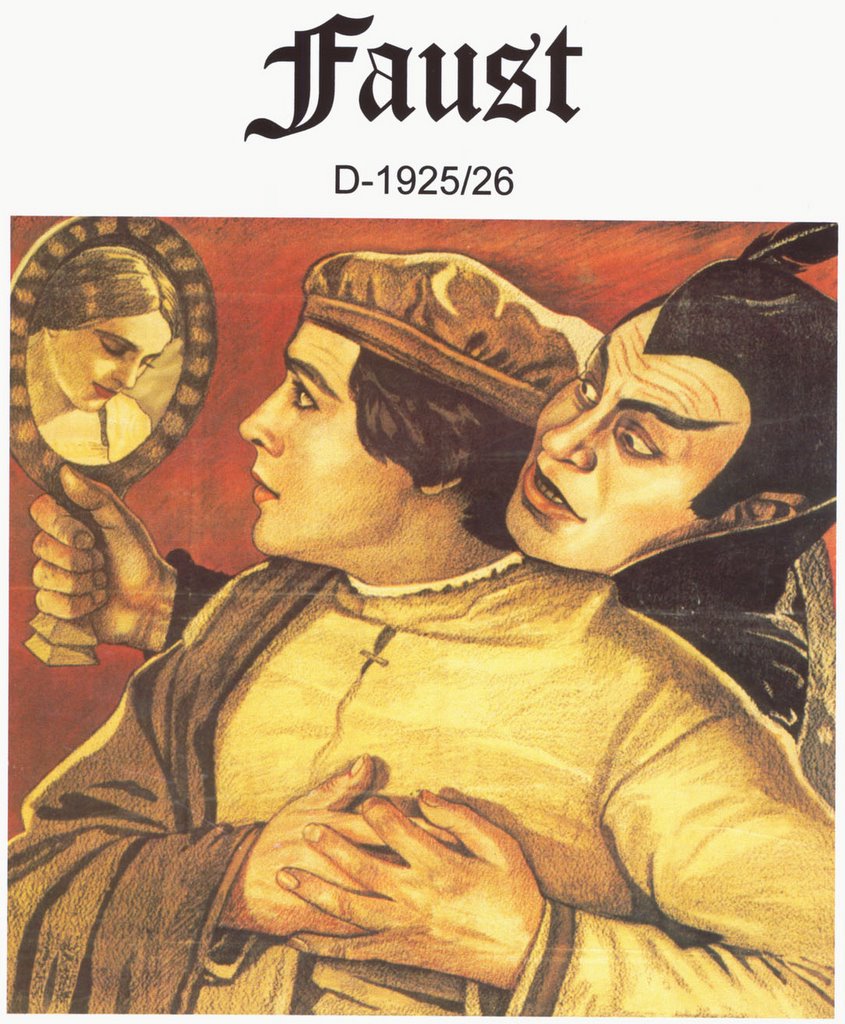
Goethe's Faust


I just read this. This is oft-regarded as a standard of sorts in the land and lore of playwrights. In it you will explore recognisable mythology, some more obscure mythology, and then realize that what you are reading has become veritable mythology itself.

So I'm always putting up dogmatic postings anymore, oh well. I find that things like that excite me enough to put pen to line, and this is what you get. Faust is me. I am a do-gooding fool who is bumbling through life trying to find fleeting joy. I find love, only to screw it all up. For all of my good works there are double the follies; not because I am oafish, but because that is simply life. And my simple life is lead about by a powerful Mephistopheles who grants my desires, only to yield a more insatiable Faust.

Hampered by death, my so-called goodness is so subjective that I can't tell that I'm doing more ill than good, I die. Mephisto lays claim on my soul, my foolish and proud soul, only to be disappointed. I am being taken away to heaven, even after all of my meddlesome and brainless deeds of dumb and bad. But why? Why am I not damned?

Goethe got it right. This story is the history of every man who ever deserved damnation but will not be damned. What was the revelation? What is the reason that I don't end up in hell? In sum, Goethe gives us his accurate appraisal:

Jan 29, 2006

The Little Match Girl, by Hans Christian Anderson

I hope that I am not infringing on any copyrights. I cut and pasted this from http://www.kidsdomain.com/holiday/xmas/stories/littlematchgirl.html so we should be okay.

I am sharing this story because it is the theme behind my new employment, Samaritan Technologies. This is a software company started by Todd McMullin and Joseph Wecker back in 1997. Yet the software developed by this company is done so not to turn a profit, not to be mass-marketed to every goon with a few extra bucks, and not to be pretentious either. Samaritan develops volunteer database software. Their product is cheaply peddled to non-profits and more expensively calibrated for government-funded agencies. It can be found in school districts, national parks, major corporations, all of whom share the need to manage volunteers.

What a wonderful concept: altruism! The spontaneous lending of a hand to another. The Christ-like charity which inspires everybody involved to keep on giving and to keep on sharing. The little girl told about in the simple children's story below exists probably in every city in the world, sad but true. Anything we can to do inspire or facilitate others in lending a hand, or an arm or a heart, is well worth it. If we are to achieve something noteworthy in this lifetime and fulfill the end of our beginning, is not charity at the heart of that? Was not charity behind Christ's suffering? Was not charity what he so often preached and practiced? Will not charity be useful to the little match girl:


Once upon a time . . . a little girl tried to make a living by selling matches in the street.

It was New Year's Eve and the snowclad streets were deserted. From brightly lit windows came the tinkle of laughter and the sound of singing. People were getting ready to bring in the New Year. But the poor little matchseller sat sadly beside the fountain. Her ragged dress and worn shawl did not keep out the cold and she tried to keep her bare feet from touching the frozen ground. She hadn't sold one box of matches all day and she was frightened to go home, for her father would certainly be angry. It wouldn't be much warmer anyway, in the draughty attic that was her home. The little girl's fingers were stiff with cold. If only she could light a match! But what would her father say at such a waste! Falteringly she took out a match and lit it. What a nice warm flame! The little matchseller cupped her hand over it, and as she did so, she magically saw in its light a big brightly burning stove.

She held out her hands to the heat, but just then the match went out and the vision faded. The night seemed blacker than before and it was getting colder. A shiver ran through the little girl's thin body.

After hesitating for a long time, she struck another match on the wall, and this time, the glimmer turned the wall into a great sheet of crystal. Beyond that stood a fine table laden with food and lit by a candlestick. Holding out her arms towards the plates, the little matchseller seemed to pass through the glass, but then the match went out and the magic faded. Poor thing: in just a few seconds she had caught a glimpse of everything that life had denied her: warmth and good things to eat. Her eyes filled with tears and she lifted her gaze to the lit windows, praying that she too might know a little of such happiness.

She lit the third match and an even more wonderful thing happened. There stood a Christmas tree hung with hundreds of candles, glittering with tinsel and coloured balls. "Oh, how lovely!" exclaimed the little matchseller, holding up the match. Then, the match burned her finger and flickered out. The light from the Christmas candles rose higher and higher, then one of the lights fell, leaving a trail behind it. "Someone is dying," murmured the little girl, as she remembered her beloved Granny who used to say: "When a star falls, a heart stops beating!"

Scarcely aware of what she was doing, the little matchseller lit another match. This time, she saw her grandmother.

"Granny, stay with me!" she pleaded, as she lit one match after the other, so that her grandmother could not disappear like all the other visions. However, Granny did not vanish, but gazed smilingly at her. Then she opened her arms and the little girl hugged her crying: "Granny, take me away with you!"

A cold day dawned and a pale sun shone on the fountain and the icy road. Close by lay the lifeless body of a little girl surrounded by spent matches. "Poor little thing!" exclaimed the passersby. "She was trying to keep warm!"

But by that time, the little matchseller was far away where there is neither cold, hunger nor pain.


I don't mean to use some emotional trick of manipulation to guilt anybody in to opening their hearts; I could stand to be much, much more charitable. I am stating that we, any and all of us, can make a difference in reducing the amount of any kind of suffering to our fellow man.

At the same time, too, when one is moved upon by the spirit of charity and reaches out to aid you, please graciously accept the favor and then pass it on. We are here to help one another, so let others help you, too.

Jan 11, 2006

Verses from Moses

(The color-coding and its semblance of Star Wars is no mere coincidence)


6. (God told Moses) thou art in similitude of mine Only Begotten (so, I am in his likeness, but what is that exactly?); and mine Only Begotten is and shall be the Savior (I am in the similitude of what?), for he is full of grace and truth (hm, those sound like attributes).

10. ...man is nothing.

12. Moses, son of man, worship me (quoth the Satan)

13. (Moses retorts) I am a son of God, in the similitude of his Only Begotten ('Savior' because he and I have good attributes; attributes I have cultivated with his help and example)

11., 14. Articulates between things spiritual and things natural

19. I am the only begotten, worship me (Satan becries)

20. Moses began to fear exceedingly (questio
ning his identity perhaps?)

32. ...by the word of my power, have I created them, which is mine Only Begotten son, who is full of grace and truth

33. (God continues) ...by the Son I created them, which is mine Only Begotten (similitude!)

39. [God's] work and glory: to bring to pass the immortality and eternal life of man


With whom do I relate? If Satanic machinations can infiltrate my self-image, my own divine connection with the Almighty God, then I am vulnerable to doubt myself, I question my worth, and my perception of my own role in the Lord's saving apparatus is eclipsed by uncertainty. It is in this moment that I sin.

What is money? How does paper and coin make a man of greater estimable worth than his spiritual peer, id est, another child of God? Why does a fleeting dollar endow one man with privilege that his brother cannot obtain? Why do we let this invention of the natural man impregnate our paradigm with the falsehood--the outright LIE--that fiscal worth can sum up the worth of a soul? Jesus never said "the worth of rich soul is great in the sight of God; the richer, the greater."

Possession of lucre is not exclusive in this context. Lust for so-called sexier thighs, fuller lips, cooler cars, etcetera, just to be accepted by MAN is a poison which we have all assimilated into our systems. Money does not prefer who its bearer is, neither do false bosoms or rugged SUVs. I am a son of GOD. So are you. So is everybody. Money, looks and other frivolities should never be passport to high notions of self-worth.
Rather the mere essence of the fact that Almighty God, Creator of the UNIVERSE, saw fit to create you and me, unique, special and loved, should yield gratitude unending, and a love of self deep and driving. Attributes that I refine by endeavoring to follow Christ's example combined with the atonement will qualify me for exaltation, not my car or what others think of it.

My sins are only symptoms of my sickness, which was (occasionally still is) self-doubt. If I merely treat the symptoms and leave the sickness unchecked, I will sin again as the symptoms return. Treating the sickness, that of low self-esteem, puts me in greater position to be grateful, which leads to humility, then diligence in righteousness, emulation, exaltation.

Love yourself. God does. You are his child.